


If you’re wondering how electrical systems efficiently connect and distribute power, busbars are likely part of the answer. They are sturdy metal strips, usually copper or aluminum, that act as central hubs for wiring.
Busbars reduce voltage drops and handle high currents with ease.
Understanding the different types and materials helps you choose the best option for your system’s reliability and efficiency.
Keep reading to learn everything you need to know about busbars and how they can optimize your electrical setup.
What Is a Busbar and How Does It Work?
A busbar is a rigid metallic strip or bar, usually made of copper or aluminum, that acts as a central electrical junction. You connect incoming power from a generator or transformer directly to the busbar. Electricity then flows along its shared conductive path. Branch circuits tap into this low-impedance bar at designated connection points, each receiving power from the same node. This design naturally helps with voltage regulation by minimizing resistive voltage drops along the distribution path. You need to select insulation materials carefully; support the busbar on insulated mounts and often enclose it within an enclosure to prevent faults. This setup provides a compact, high-capacity solution for distributing large current loads to multiple circuits, reducing heat buildup and cable clutter. Because busbars operate as a low-impedance distribution point, they can handle high fault currents safely without overheating. For safety during maintenance, removing the negative cable first prevents accidental short circuits by breaking the ground path before disconnecting the live side. When choosing a busbar system, evaluating top battery picks can help ensure compatibility with high-quality terminals that offer reliable performance and value.
Which Busbar Material Is Right: Copper or Aluminum?
Copper is generally the preferred material for busbars when maximum conductivity and compactness are required. It offers about 100% IACS (International Annealed Copper Standard) conductivity, which allows for smaller cross-sectional sizes and results in lower voltage drops. However, copper’s high density of 8.96 g/cm³ makes it significantly heavier, potentially complicating installation, especially in densely packed switchgear. For those seeking a reliable power backup solution, top solar generators provide excellent alternatives for portable energy needs. When pairing a generator with a transfer switch, ensure the transfer switch rating matches your system’s load requirements.
Aluminum provides a cost-effective and lightweight alternative. Conducting at roughly 56–61% IACS, aluminum busbars require approximately 1.6 times the cross-sectional area of copper to carry the same current. Its low density of 2.70 g/cm³ reduces weight by around 70% compared to copper, simplifying handling and supporting infrastructure. Aluminum also tends to be much less expensive—costing about 20–25% of copper per kilogram—making it attractive for large-scale or budget-conscious projects. Its softer mechanical properties and larger cross section must be considered, but its lighter weight and lower cost often make aluminum the better choice for applications where weight savings are critical.

[Package Quantity] 1pcs of 1/8" × 0.8" × 8" (3 × 20 × 204 mm) copper flat bar. Dimensions are hand-cut, so slight variations are normal. The tolerance is +0.5 to 1 mm.

One Set Included: High conductivity copper plate*1,UL standard standoff insulators*2,Stainless steel brackets*2,10 sets stainless steel washer&bolts,4 sets Expansion screws.
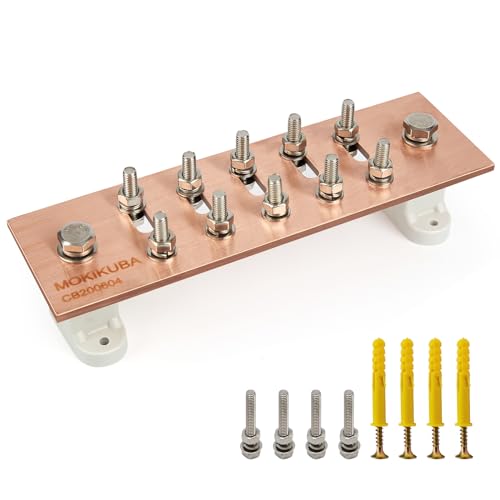
Copper conductivity test not less than 54.5 Ms/m,R≤0.0820x10-6Ω.m ;Cutting by Laser Carving for maximum accurracy.
Where Busbars Are Used in Everyday Electrical Gear
Busbars are essential components inside various electrical devices, providing high-current pathways that are more organized and efficient than tangled wiring. They are especially prominent in switchgear, panelboards, and motor control centers, where they serve as the backbone for distributing power. Instead of lengthy cable runs, busbars create short, direct paths, reducing resistance and improving system reliability. When selecting busbars for renewable energy systems, solar panel efficiency often depends on the quality and number of internal busbars used to collect current. For generator connections, choosing a cord with a 50 amp rating ensures sufficient current handling for high-demand equipment.
In battery banks and uninterruptible power supplies (UPS), busbars combine current across multiple cells, enabling compact layout and high current capacity in a limited space. Power electronics such as inverters and converters rely on busbars as low-impedance links between switching devices, which minimizes voltage drops and enhances performance. Color coding on busbars helps with quick identification during installation or troubleshooting, reducing errors and speeding up maintenance procedures. Similar to how cable glands provide a secure entry point, busbars rely on proper insulation and termination to prevent accidental contact and ensure safe operation.
Additionally, busbars are used in building distribution systems through busway channels that route power efficiently, eliminating the need for extensive cabling. Their durable construction withstands vibrations and mechanical stresses common in industrial environments, ensuring long-term stability and safety.

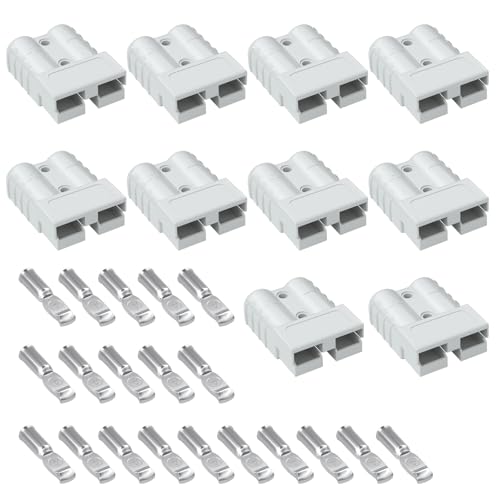
Product Description:50 Amp Battery Quick Disconnect Connector for 6-12AWG cable.Voltage: 600V

Provides simple and convenient method for disconnecting power to a winch or other electrical device.
The Main Types of Busbar Systems (Including Laminated)
Several main types of busbar systems serve different needs based on complexity, reliability, and application. The simplest is the single busbar, which features one continuous conductor handling both incoming and outgoing feeders. This setup is suitable for low-cost, straightforward systems but has the drawback that a fault on the busbar interrupts the entire section. Double busbar systems improve reliability by allowing transfer of circuits between two sections during maintenance or faults, minimizing downtime. Isolated phase busbar systems separate each phase’s enclosure, greatly reducing the risk of phase-to-phase faults, making them ideal for high-current, large-power transfer applications. Busbar trunking offers modular, enclosed sections that are rated from 160 A to 6300 A, making installation easier and adaptable to various environments. Laminated busbars stack copper layers with thin dielectric insulators, which lower inductance and are especially important in power electronics for efficient high-frequency performance. The size and insulation materials of busbars are critical factors that determine their performance limits and must be selected carefully based on current-carrying capacity and operational demands.
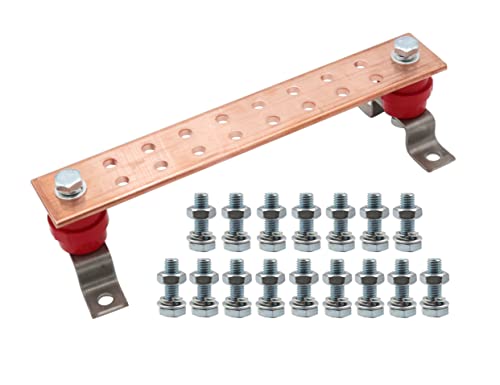
1.Wall mounted .24"x 1.97"x 11.8" (6×50×300mm) copper ground bar kit, copper grounding busbar.
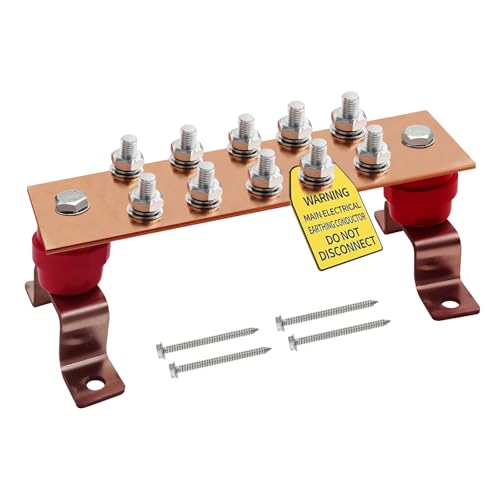
One Set Included: High conductivity copper plate*1,UL standard standoff insulators*2,Stainless steel brackets*2,10 sets stainless steel washer&bolts.

GOUNENGNAIL branded Copper Ground Bar 1/4"(metric 6mm thick) x 2" (Metric 50mm wide) x 10" (metric 250mm long) with 1/4'' * 16 Terminal Positions. With SM40 polyester insulators made from UL material - QMFZ2.E252110,Rated Uimp up to 7.4kV.
Why Busbars Outperform Cables for High-Current Jobs
Busbars outperform cables for high-current applications primarily because they offer lower resistance and voltage drop. Their solid metal profiles, often made of copper or aluminum, create a continuous conductive path that minimizes energy loss. This design enables busbars to carry thousands of amperes in a compact footprint, reducing the need for multiple parallel cable runs. Additionally, their broad surface area allows for more efficient heat dissipation, which lowers thermal stress and enhances safety. Fewer joints in busbar systems mean fewer failure points and faster installation times. From an environmental perspective, busbars use less copper for the same current capacity, decreasing raw material demand. Their manufacturing processes tend to generate less scrap compared to cable extrusion, contributing to a more eco-friendly footprint. Overall, busbars reduce electromagnetic interference and lower the total cost of ownership in fixed, high-power electrical infrastructures.

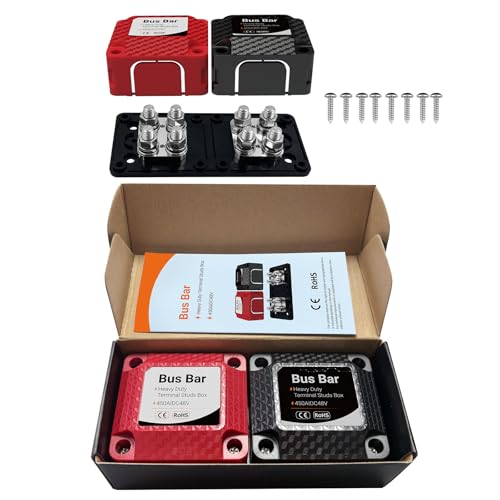
450A High Current & 48V DC Compatibility: Handles up to 450A continuous current and 48V DC voltage, perfect for heavy-duty electrical systems. Red busbar for positive (+) and black for negative (-) connections, ensuring clear polarity for marine, automotive, and solar applications.

Red copper, thick copper, nickel-plated, strong current, durable, wear-resistant, sturdy,easy to install, quality assurance, suitable for a variety of lithium batteries
How to Select Busbars by Current Rating, Material, and Space
To select a busbar by current rating, determine the required ampacity based on your load. The cross-sectional area directly influences this and is calculated using the formula \(A = I / J\), where \(I\) is the current and \(J\) is the current density. Typical current densities are about 1.2 A/mm² for copper in enclosed panels and around 0.8 A/mm² for aluminum. This estimate ensures your busbar can handle the load safely without excessive heating, optimizing current density. Similar to ensuring a proper AGM battery charge process, maintaining the correct thermal balance is critical for extending the lifespan of electrical components. Always clean solar panels according to a safe procedure to prevent debris from contributing to corrosion on electrical connections. Regularly inspecting these connections for signs of wear mimics the same vigilance required to maximize solar panel lifespan through proactive maintenance.
When choosing material, copper allows for a smaller cross-section thanks to its higher conductivity, making it ideal when space is limited. Aluminum, on the other hand, requires roughly 1.6 times the cross-sectional area of copper to carry the same current but offers a weight advantage. Weighing factors like space constraints against weight and cost help in selecting the appropriate material.
Additionally, consider the busbar’s geometry to fit space restrictions. Wider bars may provide the same or greater current capacity as thicker ones and often promote better thermal distribution. Ensure you also evaluate thermal management, verifying that the busbar’s temperature rise stays within safe limits considering ventilation and ambient temperature. Safety margins, short-circuit withstand capabilities, and electrodynamic force effects must be checked according to relevant standards before finalizing the size and material.
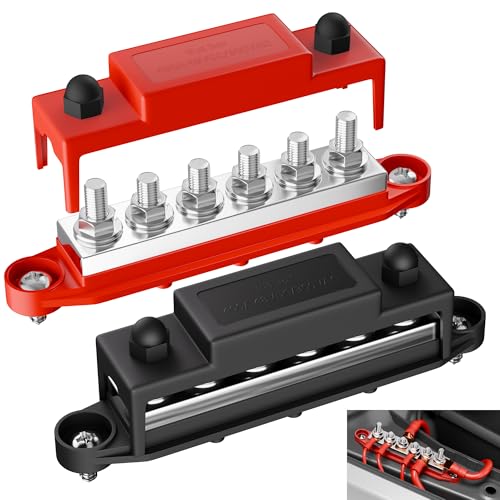
400A Heavy Duty: The 12V-48V Bus Bar rated 400A, besides, this power distribution block can work with MAX 48V DC & 300V AC

400A Heavy Duty: The 12V Bus Bar rated 400A, besides, this power distribution block can work with MAX 48V DC & 300V AC

✔️ HEAVY-DUTY 150A POWER HANDLING - Engineered for high-performance electrical systems, this power distribution block supports up to 150A continuous current and a maximum operating voltage of 48V DC. It ensures reliable power distribution for demanding applications without overheating or voltage drop.
Safe Busbar Installation and Maintenance Tips
To ensure safety during busbar installation, start with pre-installation safety controls. De-energize the system, disconnect it from the mains, and secure it against reconnection before handling or assembly. Confirm the system is offline using appropriate testing devices. Carry out earthing and short-circuiting according to specified grounding procedures to prevent accidental energization. Use only approved tools and bracketing systems designed for busbar installation to maintain mechanical stability. Always verify that your busbar’s voltage and current ratings align with the product specifications before you energize the system. For example, even a modest busbar’s mechanical support must withstand forces comparable to a cable tie’s tensile strength, which is often rated in pounds or newtons. Similarly, first-time users should ensure they wrap the tie securely around the busbar to prevent slippage, just as beginners are taught to adjust the tension properly when using velcro cable ties. When selecting a charger for the battery system connected to the busbar, prioritize models with automatic voltage detection to prevent overcharging and ensure compatibility.
What Makes Laminated Busbars So Compact and Reliable?
Laminated busbars are highly compact because their layered construction integrates multiple conductive and insulating materials into a single rigid unit, reducing installation space by up to 70%. This design allows you to adopt flexible configurations and modular setups, simplifying routing in high-density inverter and electric vehicle powertrain applications. Their close coupling of positive and negative conductors within sub-100-micrometer separations drastically reduces stray inductance—by approximately 50% compared to traditional layouts—helping to minimize parasitic effects that can cause voltage overshoot and switching stress. The laminated structure improves thermal performance through large flat surfaces that evenly distribute heat, while PET insulation rated to 105°C ensures long-term reliability. Uniform current distribution across layers prevents localized heating, enhancing durability. Additionally, fusing the layers together eliminates wiring errors and reduces vibration-induced failures, resulting in a mechanically robust assembly that can withstand demanding operational conditions. For reliable integration with external systems, many laminated busbars are paired with MC4 connectors to ensure secure and efficient power transmission in solar applications. When used in a solar generator setup for a fridge and freezer, a proper sizing chart ensures the busbar can handle the necessary surge and run load without overheating. Using a solar power meter allows you to verify the actual power output from such a busbar-integrated system by reading real-time generation data.