


Wondering if your AGM battery is still good? Knowing how to test it properly can save you money and prevent unexpected failures.
By checking its voltage and applying a proper load, you can get a clear idea of its true condition.
Keep reading to discover straightforward steps that can help you accurately assess your battery’s health.
Why You Should Test Your AGM Battery (Even If It Seems Fine)
Even if your AGM battery shows a normal voltage at rest, hidden capacity loss may already be underway. Relying solely on open-circuit voltage can be misleading because it doesn’t reveal declining performance under load. Load testing is essential because it exposes weak performance when the battery is demanded to deliver power, which can signal fading capacity long before complete failure. For example, ensuring your battery’s connections are as secure as a quality breaker box can prevent erroneous test readings. Deep cycle batteries naturally lose capacity over time, but sulfation and internal damage accelerate that decline significantly.
Internal resistance rises as sulfation and other internal damage develop, reducing performance without causing immediate starting issues. A battery may pass a quick voltage check after charging but still fail under load due to sulfation or internal deterioration. Low-voltage readings after a full charge are a clear indicator of capacity loss and internal issues. Comparing your test results against top battery picks can help you identify whether a replacement offers better performance and value.
Regularly testing your battery allows you to detect early signs of degradation, enabling targeted maintenance efforts. This proactive approach helps prevent sudden failures, protects voltage stability in your system, and extends battery life. Routine load testing—done monthly—is a simple yet powerful step to reduce the risk of being stranded, avoid unnecessary replacements, and keep your electronics running smoothly and reliably.
What You’ll Need to Test an AGM Battery
To test your AGM battery properly, you’ll need several specialized tools. Start with a digital multimeter, which measures DC voltage to give you an initial idea of the battery’s state. An auto-ranging multimeter simplifies the process by automatically selecting the correct range, reducing user error. Next, use a battery load tester to simulate the engine’s starting current, revealing how well your battery performs under normal stress conditions. For more detailed analysis, a conductance analyzer with AGM-specific modes evaluates the battery’s overall health and charge capacity. For reliable results, look for top rated battery testers that combine accuracy with user-friendly features. Additionally, ensure all connections are clean and tight, similar to battery disconnect switch installation practices for safe and accurate testing. Many high-quality solar panels also rely on MC4 connectors for secure and efficient power transmission.
Safety gear is essential: wear protective gloves and safety glasses to prevent accidents during testing. Terminal cleaning is also crucial to ensure solid test connections, which prevent false readings. You should have an AGM-compatible charger on hand to fully charge the battery before performing load tests again. Additionally, gather the battery’s cold cranking amps (CCA) and amp-hour (Ah) rating to set up load tests accurately. Collecting all these tools beforehand helps you avoid guesswork and ensures a thorough assessment.

Catch Battery Problems Early: Featured in two videos by Project Farm, a popular YouTube channel with millions of subscribers, the ANCEL BA101 helps you quickly spot battery issues before they leave you stranded. It provides easy-to-understand readings for State of Health (SOH), State of Charge (SOC), voltage, current, CCA, plus cranking and charging system tests, so you can better understand your battery and help avoid unexpected breakdowns

[Car Battery Tester] You can easily test and inspect your 12V lead-acid battery with this TOPDON car battery tester. The SOH (State of Health), SOC (State of Charge), Voltage, Current, Rating, and numerous other understandable analytical data are provided by this battery tester. It is compatible with 100-2000CCA regular flooded, AGM flat plate/spiral, EFB, and GEL for their optimum performance.

【Professional-Grade Accuracy for All 12V & 24V Batteries】Experience lab-grade precision with the TOPDON car battery tester and alternator tester. Employing advanced conductance technology, it delivers 99.9% accurate results for any 12V or 24V automotive battery (100-2000 CCA), including regular flooded, AGM, GEL, and deep-cycle types. This auto battery tester is your essential tool for reliable DIY battery checks, pre-road trip vehicle preparation, and professional diagnostics in home garages or auto shops, ensuring you never get a false reading.
How to Test AGM Battery Voltage With a Multimeter
Set your digital multimeter to the DC voltage setting, choosing a range above 12V, typically the 20V DC range, to properly measure a 12V AGM battery. Ensure the meter displays a steady voltage, not current or resistance. Connect the red probe to the battery’s positive (+) terminal and the black probe to the negative (−) terminal; proper contact on the posts is essential. Reversed probes will give a negative reading, which indicates incorrect placement. Before testing, turn off all loads and let the battery sit undisturbed for 2 to 4 hours, allowing it to rest and surface charge to dissipate. This open-circuit voltage reading provides an accurate measure of the battery’s state of charge. Typically, a fully charged AGM battery reads around 12.8 to 13.0 volts. If the reading falls below 12.4 volts, the battery is partially discharged, and below 12.0 volts suggests deep discharge. Carefully secure your probes to the terminals to ensure precise readings, and take multiple measurements to confirm consistency. For reliable backup, pairing your battery with a top solar generator ensures consistent power and performance. This process uses the same attention to clean, reliable connections that is required when cutting cable ties for a secure finish.
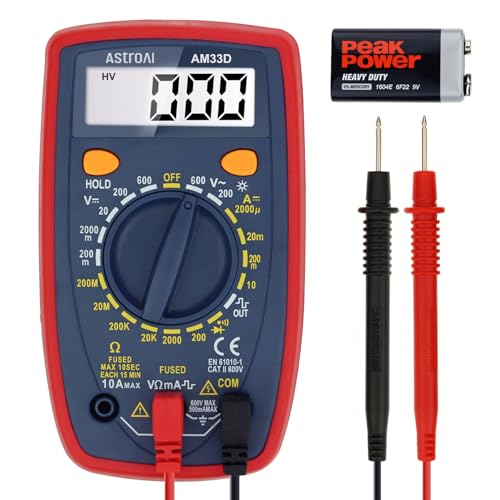
Additional Tips - The following incorrect operations may cause the multimeter not to show results: Firstly, the plugs of test leads are not fully inserted or not inserted into the correct sockets. Secondly, the manual rotary switch is not placed in the correct position. In addition, this meter can not test all AC Current and below 100mV AC Voltage. Please check the user manual carefully before measurement.

Accurately Test Full Features: Accurately measures AC/DC voltage, DC current, resistance, continuity test, diode and batteries.

VERSATILE FUNCTIONALITY: Measures AC/DC voltage up to 600V, 10A DC current, 2MΩ resistance; additional features include continuity, diode test and battery test
What Your AGM Battery Voltage Reading Means
Measuring the open-circuit voltage of your AGM battery provides a clear indication of its state of charge. A reading from 12.8V to 13.0V after the battery has rested for several hours shows a fully charged, healthy cell, with 12.85V representing 100% charge. If the voltage falls between 12.5V and 12.84V, your battery is approximately 80% to 99% charged—usable but not fully topped off. A voltage from 12.2V to 12.3V indicates about a 50% charge, signaling that a recharge is necessary soon to prevent damage. When the reading drops below 12.0V, your battery has less than 25% charge remaining, and near 10.5V suggests a complete discharge. Keep in mind that voltage readings estimate the charge level but do not reflect the overall health or capacity of the battery. Repeatedly measuring voltage below 12.4V can shorten your battery’s lifespan. Always take the measurement after the battery has been at rest, not under load or during charging, to get an accurate reading. For a more thorough check, a simple load test can be performed using a multimeter or a headlight to simulate real-world usage. To ensure your charging system is reliable, consider top power inverters for maintaining consistent power delivery. Just as safely cleaning solar panels requires a careful approach, testing your AGM battery with a voltage reading after a rest period prevents false results and extends battery life.
How to Load Test Your AGM Battery Correctly
Before load testing an AGM battery, ensure it is fully charged and has rested for at least an hour, longer if recently discharged or charged. Surface voltage can distort the results, so allowing the battery to stabilize is crucial. Disconnect all loads and chargers, then inspect terminals and cables for signs of damage. For a home-made setup, always respect the safety limits of your DIY components to avoid overheating or fire. Always verify that your load tester is designed for AGM battery compatibility to prevent damage during testing. Working near an outdoor electrical panel requires knowing how to safely open and inspect the enclosure before connecting any gear.
Set your tester to the appropriate rating: use half of the cold cranking amps (CCA) for starting batteries, or approximately three times the amp-hour (Ah) rating for deep-cycle batteries. Connect the red clamp to the positive terminal and the black to the negative, ensuring the tester is compatible with AGM batteries.
Apply a steady load for 10 to 15 seconds while continuously monitoring voltage. A healthy 12-volt AGM battery should stay at or above 9.6 volts near 70°F. If the voltage drops below this threshold, recharge the battery fully and retest. A second failure indicates it is time to replace the battery—never skip this verification step.

[CONVENIENT]: Whether for the home, garage, or at the shop, the Neiko battery load tester is portable and DIY compatible for diagnosing and applying load to car, van, boat, truck, SUV, motorcycle, RV and other automotive 6 & 12 volt batteries.
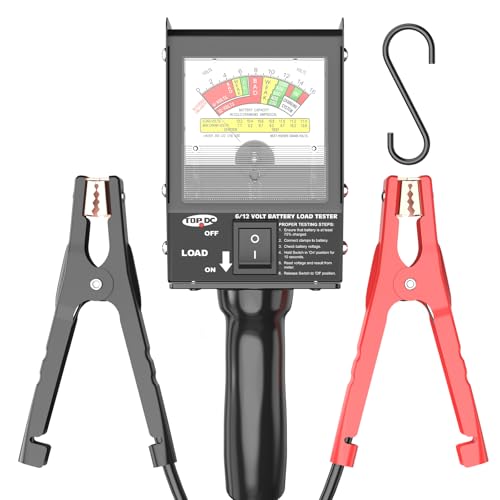
Quick & Accurate Diagnosis: Engineered for efficiency, this battery tester delivers precise results in seconds, helping you quickly determine the health and charging status of your automotive battery.
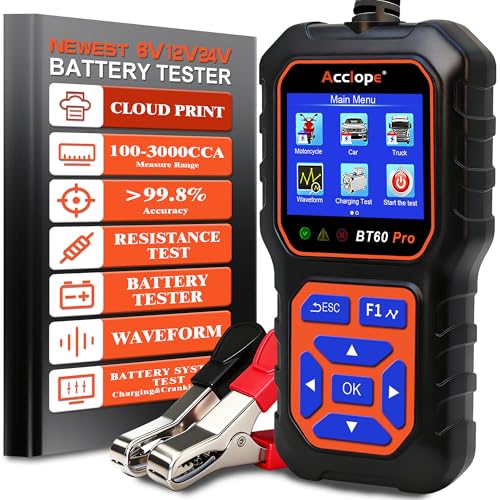
Wide Battery Compatibility: The ACCLOPE BT60 PRO supports 6V, 12V, and 24V batteries, including lead-acid, AGM, GEL, EFB, and lithium batteries. LiFePO4 support is limited to voltage/health checks and does not guarantee precise CCA(100-3000) measurement. The device is not compatible with 48V systems. Battery Tester Only - NOT OBD2 / NOT a Code Reader (Does NOT read/clear DTC). This versatile car battery tester provides reliable diagnostics for professionals and DIY users, making it an essential tool for diverse battery testing needs
Three Signs Your AGM Battery Is Failing
You’ll notice your AGM battery is failing when you experience slow cranking and weak starting signals. The engine turns over sluggishly, especially in cold weather, because the battery can’t deliver its rated cold-cranking amps. This issue directly indicates degraded battery chemistry, which reduces its ability to provide quick bursts of power needed to start your vehicle. Deep discharging is a primary cause of accelerated degradation in AGM batteries. If you see this sign, it’s a strong clue that your battery’s internal health is deteriorating and may soon leave you stranded. Before assuming the battery is dead, always verify that all terminal connections are clean and tight, as loose or corroded links mimic the same weak-start symptoms and are a common installation oversight.

Quantity: comes with 10 pieces battery anti-corrosion washers(5 red & 5 green) and 2pcs Battery Terminal Cleaning Brush.

【Effortlessly removes corrosion】The dual-ended battery post cleaning brush, made of stainless steel casing and with steel wire bristles, powerfully removes stubborn corrosion and oxides from battery terminals and clamps, ensuring optimal conductivity. In winter, clean terminals will help your car start more easily while reducing battery drain.

Don’t Make These Mistakes When Testing Your AGM Battery
Misidentifying your AGM battery type is a common mistake that can skew testing results. Always select the correct AGM setting on your tester to avoid damage or unnecessary replacements. Using a flooded-battery profile on an AGM can lead to inaccurate readings or harm the battery. Never test the battery before it is fully charged; a low state of charge can falsely indicate failure. If voltage is low, recharge the battery first, then let it rest for 8 to 12 hours to dissipate surface charge. Skipping this step causes inflated voltage readings that hide the real condition of the battery. Avoid generic testers, as they often lack AGM-specific parameters, which are crucial for accurate results. Conduct a load test at half the battery’s cold cranking amps (CCA) rating for 15 seconds; during this test, the voltage should stay above 9.60 volts at 70°F or higher. Remember to account for ambient temperature, because cold weather can depress voltage readings and cause a false failure. Paying attention to these details helps prevent costly mistakes and keeps your AGM battery in top shape.

[12V/24V Lead-Acid & Lithium Dual Battery Tester]: One Tester for All Your Vehicles! The ANCEL BT410 car battery tester offers wide compatibility, supporting 12V 24V systems and working with both lead-acid (AGM/GEL/Regular Flooded/EFB) and lithium-ion batteries. You won’t need separate tools for your car, truck, RV, motorcycle, or boat—no more hassle of wondering, “Will this battery tester work with my automotive battery?”
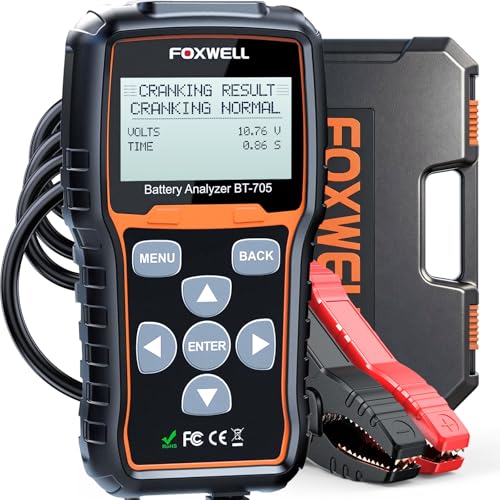
𝗧𝗥𝗨𝗦𝗧𝗘𝗗 𝗔𝗖𝗖𝗨𝗥𝗔𝗖𝗬, 𝗕𝗘𝗧𝗧𝗘𝗥 𝗕𝗔𝗧𝗧𝗘𝗥𝗬 𝗗𝗘𝗖𝗜𝗦𝗜𝗢𝗡𝗦: Used in Project Farm’s 2026 battery comparison, FOXWELL BT705 car battery tester checks CCA, voltage, internal resistance and SOH, including during 32°F (0°C) battery testing. Clear, consistent results help catch weak batteries early, verify a newly purchased battery before installation and avoid replacing a good one

[12V Battery Tester] The BT300P is a quick and accurate battery tester that offers printed diagnostic receipts. Know everything about the health of 12V batteries, the 12V & 24V starter motor’s cranking status, and 12V & 24V vehicle electronic system’s charging condition. This is TOPDON’s newly developed battery tester that ensures your batteries are always working at an optimum level.
How to Fix Common AGM Battery Testing Mistakes
Correcting common AGM testing mistakes begins with proper battery-type identification. Many DIYers and even seasoned techs default to the flooded setting on their tester without checking the label, which skews charge-voltage targets and can falsely identify a healthy AGM battery as bad. Always verify the battery’s labeling before connecting and ensure you’re using the AGM-specific mode rather than the nominal 12V setting. These modes account for the different voltage characteristics of AGM batteries, ensuring accurate test results. For those operating a backup power system, using a generator interlock kit helps safely coordinate battery testing with generator usage.
Next, stabilize the battery to get a reliable reading. After charging, let the battery rest for at least 10 to 12 hours; surface charge can temporarily inflate voltage readings and give a false impression of health. If you need immediate results, applying a brief accessory load can help dissipate surface charge faster. Avoid testing immediately after charging to prevent inaccurate readings. For systems incorporating renewable energy, understanding the role of a hybrid inverter can help you integrate and test AGM batteries within a complete power setup. When choosing a backup unit, review a portable power station with solar panel buyer’s guide to compare quality and performance.
Use a load test lasting 15 seconds at half the CCA rating rather than a quick static check. In this test, hold the voltage at 70°F for a minimum of 9.6 volts; lower voltages indicate possible issues. Adjust the target voltage for colder temperatures, as cold weather reduces battery capacity and voltage benchmarks.
Finally, always inspect the battery case and terminals before testing. Swollen cases or cracked seals can compromise results. If you find a battery that appears damaged but still shows a good voltage, charge it fully and retest. A rapid voltage drop after a full charge suggests internal issues, and replacement is recommended.