


Ever wondered if your battery is truly healthy or just appears to be? A good battery tester gives you more than just a voltage reading – it reveals hidden issues that can cause your battery to fail unexpectedly.
By checking internal resistance and other factors, it provides clear, actionable insights into your battery’s condition.
The rest of this article unlocks how these testers work and what the results really mean.
What a Battery Tester Does: and When You Actually Need One
A battery tester provides a clear assessment of your battery’s condition, not just a voltage reading. It evaluates the battery’s ability to deliver sufficient power during actual use. By applying a controlled load or a small AC signal, it monitors how voltage drops under load or how conductance responds. This process converts resistance measurements into a pass or fail result or assigns a cold-cranking rating, giving you a practical indication of battery health. Unlike a multimeter, a battery tester is designed for specific battery types and load testing. For example, comparing top battery picks with terminals can help you understand which tester features matter most for quality and performance. Choosing a tester with a wall outlet allows you to plug in other devices while testing, similar to the convenience found in top-rated power banks.
You’ll need a battery tester when your vehicle struggles to start, your tools seem weakened, or backup power systems show signs of failure. Different testing methods suit various battery types—such as automotive lead-acid or lithium-ion packs—so you get an insight into their true health, not just their voltage. Using a tester helps catch weak cells early, avoid unnecessary replacements, and ensure safer maintenance for industrial, UPS, or household batteries.

Catch Battery Problems Early: Featured in two videos by Project Farm, a popular YouTube channel with millions of subscribers, the ANCEL BA101 helps you quickly spot battery issues before they leave you stranded. It provides easy-to-understand readings for State of Health (SOH), State of Charge (SOC), voltage, current, CCA, plus cranking and charging system tests, so you can better understand your battery and help avoid unexpected breakdowns

【Reliable Automotive Car Battery Tester】 KW208 is the most cost-effective battery load tester compared to other brands, it has all the functions you need and the lowest cost that you can afford. KW208 can test all 12V batteries(100-2000CCA) including regular flooded, AGM flat plate, AGM spiral or gel batteries. Provide overall analysis of batteries’ condition and help you know their status in advance before it dies. KW208 battery analyzer supports cranking and charging system tests also alternator and starter test. Conveniently store this car battery tester for batteries in your glove box or garage, ready for use whenever needed.

[Car Battery Tester] You can easily test and inspect your 12V lead-acid battery with this TOPDON car battery tester. The SOH (State of Health), SOC (State of Charge), Voltage, Current, Rating, and numerous other understandable analytical data are provided by this battery tester. It is compatible with 100-2000CCA regular flooded, AGM flat plate/spiral, EFB, and GEL for their optimum performance.
Why Voltage Testing Only Tells You Part of the Story
Voltage readings only provide a partial picture of your battery’s health. While a quick snapshot of charge level, they do not reveal the internal condition or aging signs. An open-circuit voltage tells you how much charge remains but doesn’t indicate internal resistance, sulfation, or plate degradation. The battery may show a healthy 12.6 volts at rest but still fail under load, collapsing when you demand current. Chemical composition and manufacturing quality influence true performance, yet voltage hides those details entirely. A battery tester measures how the battery performs under an applied load to detect these hidden flaws. Remember, a full charge does not mean the battery is in good shape; it could be worn out or internally compromised. To truly assess a battery’s health, you need to look beyond simple voltage and consider other tests and indicators. Voltage testing is only the starting point; it won’t tell you everything about your battery’s real-world capacity. In fact, the condition of the entire power delivery system, including the battery cables that carry current, can skew results and cause similar hidden failures. Similarly, understanding the difference between a lightning arrester and surge arrester helps clarify how protection devices handle sudden electrical spikes.
How a Battery Tester’s Load Test Reveals Real-World Performance
A load test reveals a battery’s true starting power by applying a controlled draw of current, typically half the Cold Cranking Amps (CCA) rating for 10 to 15 seconds. This simulates the demand created by your starter motor during engine cranking. You connect the tester directly to clean battery posts and observe the voltage during the test. The voltage must stay above 9.6 volts at 70°F; if it drops sharply below this, the battery likely has weak plates or failing cells. Resting voltage alone can be misleading because it may appear normal even when the battery cannot deliver sufficient power under load. Properly charging the battery before testing is essential because an undercharged battery might falsely pass or fail the test, leading to inaccurate results. Always use the correct tester specifications to ensure the load applied matches the battery’s CCA rating for a valid test outcome. A load test doesn’t just measure charge; it confirms whether your battery can provide reliable cranking power when it’s needed most. For safety, know how to tighten metal cable ties to secure your battery connections without damaging the posts. When selecting a generator extension cord, ensure it has the proper gauge to handle the current without voltage drop over long distances.

Versatile Battery Load Tester & Voltage Tester: Effectively check the battery and voltage of various vehicles including cars, trucks, RVs, and golf carts. This powerful diagnostic tool ensures accurate results for both 6V and 12V batteries.
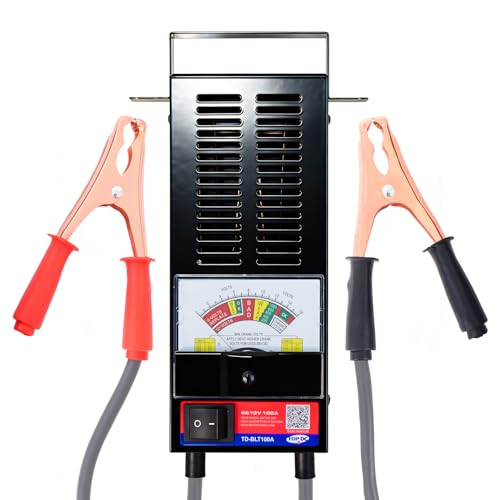
COMPATIBILITY: Works with 6V and 12V batteries, perfect for testing cars, motorcycles, RVs, boats, ATVs, and other vehicles with rubber insulated carrying handles for easy transportation.

[12V Battery Tester] The BT300P is a quick and accurate battery tester that offers printed diagnostic receipts. Know everything about the health of 12V batteries, the 12V & 24V starter motor’s cranking status, and 12V & 24V vehicle electronic system’s charging condition. This is TOPDON’s newly developed battery tester that ensures your batteries are always working at an optimum level.
How a Battery Tester Uses Conductance to Check Health Without Draining
A conductance tester measures your battery’s internal condition without draining it. It does this by applying a small alternating-current signal and analyzing how easily current flows through the internal paths. Higher conductance means lower internal resistance, indicating your battery can deliver power efficiently. Results are displayed in Siemens or mhos, often translated into internal resistance for clarity. Because this method doesn’t drain the battery, you can perform repeated tests without losing charge. It works on partially discharged batteries and takes less than two minutes to complete. For accurate results, ensure terminal connections are clean and tight, as corrosion or loose clamps can distort readings. This non-destructive approach detects aging by identifying decreasing usable plate area, as well as shorts or opens inside the battery. Regular conductance checks can help you spot warning signs of ageing before your portable power station fails entirely, similar to how top solar-powered batteries undergo routine health monitoring to ensure long-term efficiency. It is a fast, practical tool for routine health checks that does not compromise your battery’s remaining charge.

🔥【A MUST HAVE TOOL IN YOUR GARAGE】 - With up-to-date testing technology, it provides a quick reading to determine whether a vehicle battery needs a jump or replacement and also the output status of the alternator. All you have to do is log in and play. Save your time and money.

[Built-In Thermal Printer]: This battery load tester prints clear 12V/24V test reports in seconds—no phone, app, ink, or cartridges needed. Keep printed reports for customer reference, service records, and future comparisons

【Professional-Grade Accuracy for All 12V & 24V Batteries】Experience lab-grade precision with the TOPDON car battery tester and alternator tester. Employing advanced conductance technology, it delivers 99.9% accurate results for any 12V or 24V automotive battery (100-2000 CCA), including regular flooded, AGM, GEL, and deep-cycle types. This auto battery tester is your essential tool for reliable DIY battery checks, pre-road trip vehicle preparation, and professional diagnostics in home garages or auto shops, ensuring you never get a false reading.
How a Battery Tester Calculates Pass or Fail Using Your Battery’s CCA Rating
You need to enter the battery’s rated Cold Cranking Amps (CCA) from its label before testing; this number serves as your reference point. The tester uses this input to set a benchmark. It then applies a load—usually about half of the rated CCA—for approximately 15 seconds. During this time, it measures the voltage. At 70°F, a voltage reading of at least 9.6 volts indicates the battery passes. If the voltage remains above this threshold, the battery is healthy; if it drops lower, it fails. This process is similar to how a breaker box manages electrical load to prevent system failure.
The tester also estimates the CCA by assessing the battery’s internal resistance. Higher internal resistance, often caused by aging plates slowing chemical reactions, reduces the battery’s ability to deliver current. The tester compares this estimated CCA to the entered rating. A result near or above the rated CCA shows the battery can start your engine reliably. A significantly lower result indicates deterioration. Many modern testers now use MC4 connectors to securely attach to battery terminals for consistent readings. Always double-check the battery label for the correct CCA before testing, as entering an incorrect number can skew results. To avoid errors, use a charger with a gel battery setting to ensure the correct charging profile protects the battery’s health during maintenance.