


Ever wonder how you can measure electric current without unplugging or shutting down a circuit? A digital clamp meter is your go-to tool for doing just that. It offers quick, safe readings on live circuits by clamping around a single conductor—no need to disconnect anything.
This device also doubles as a multimeter for measuring voltage and resistance, making it a versatile addition to your toolkit.
Keep reading to learn how to choose the right clamp meter for your specific needs.
The Digital Clamp Meter Defined
A digital clamp meter combines a digital multimeter with a non-contact current sensor, allowing you to measure amperage without breaking the circuit. Its design has evolved from analog, transformer-based models to modern digital systems that rely on Hall-effect sensors for measuring direct current (DC). The device features a handheld body made from impact-resistant ABS plastic, which ensures durability during regular use. The clamp jaws are typically made of precision-wound ferrite cores, which effectively detect magnetic fields around conductors. For users seeking reliable performance, selecting a model with quality battery terminals can improve connection stability and measurement accuracy.
To use the meter, you simply operate the hinged jaws to clamp around a single conductor. This non-intrusive method detects the electromagnetic field generated by the current without the need to disconnect or insert the meter into the circuit. The digital display then shows the numerical reading instantly, enabling quick and safe troubleshooting of live circuits. This approach prioritizes safety by reducing exposure to live wires and enhances measurement accuracy with advanced sensor technology. Understanding how these meters regulate their own power consumption and protect against surges is similar to the charge controller’s role in a solar system, which manages battery voltage and prevents overcharging. For best results in grounding applications, ensure the conductor material matches the bare copper wire specifications used in your system.

2 in 1 Voltage & Current Meter: This amp voltage meter monitors both real-time voltage and current in one device, eliminating the need for separate meter, red indicates voltage, green indicates current
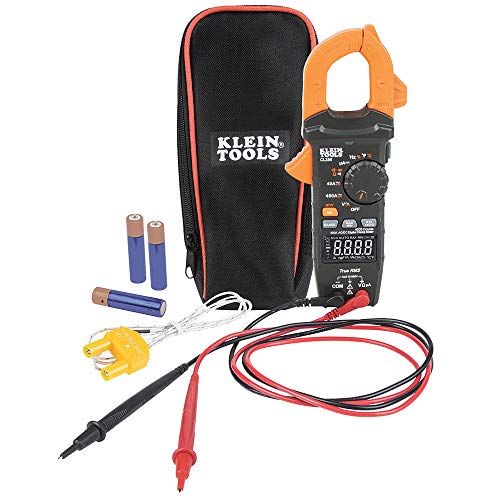
VERSATILE CLAMP METER: Measures AC/DC current and NCVT via clamp; AC/DC voltage, resistance, continuity, frequency/duty cycle, DC microamps, diode test and capacitance via test-leads; temperature via thermocouple
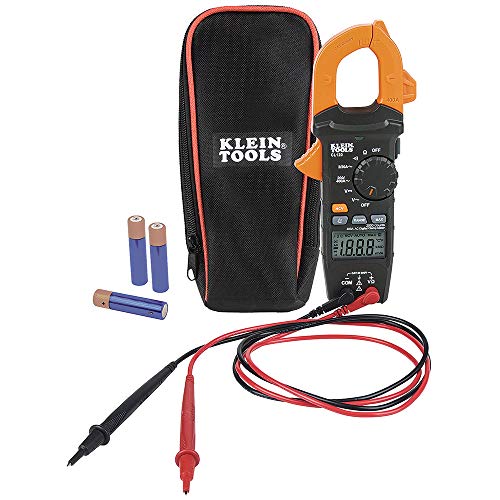
VERSITILE CLAMP METER: Measures AC current and NCVT via clamp; AC/DC voltage, resistance, and continuity via test-leads
When Should You Use a Clamp Meter Instead of a Regular Multimeter?
Use a clamp meter instead of a regular multimeter when measuring live current without interrupting service. Its non-invasive jaw design allows you to clamp around a conductor without opening the circuit, reducing shock risk and making it safer for high-current testing on motors, feeders, and distribution panels. While clamp meters excel for quick, non-contact readings and immediate load checks, they generally offer less precise measurements than a multimeter, which connects directly in series for detailed voltage, resistance, and component testing. However, for installations like a generator setup, a clamp meter can quickly check the current on the main feeder wires of a transfer switch without needing to shut off power. For instance, when selecting a power inverter for batteries, a clamp meter helps quickly verify current draw from the battery bank without disconnecting cables.
Opt for a multimeter when you need accurate readings of voltage, resistance, or to test components within low-power circuits you can safely disconnect or open. Clamp meters are best for rapid assessments in energized systems, especially for gauging overloads or initial troubleshooting. Using both tools together can streamline diagnostics: start with the clamp meter to identify current issues quickly, then switch to the multimeter for detailed analysis and fine measurements.

Compact, easy-to-use clamp meter with 30 mm large jaw taking measurements on large conductors

【10000 Counts TRMS Clamp Meter】FNIRSI DMC-100 digital clamp multimeter provides stable TRMS measurement for AC/DC current up to 600A, voltage, resistance, capacitance, frequency, and temperature. It integrates NCV detection, live wire testing, continuity, and diode checks to support multi-function electrical diagnostics in maintenance and repair scenarios

【5-in-1 Multifunctional Clamp Meter】Covers AC current (2A/20A/200A/400A max), AC/DC voltage (600V max), resistance (20MΩ max), continuity & diode polarity detection; one-click function switch via FUNC button meets daily & professional electrical measurement needs.
How Does a Clamp Meter Measure Current Without Touching the Wire?
A clamp meter measures current without touching the wire by sensing its magnetic field. For AC current, it uses magnetic induction: the conductor inside the clamp acts like a transformer’s primary winding, and the meter’s internal coil functions as the secondary. The time-varying magnetic field from the AC current induces a proportional current in the meter’s coil, which is then displayed. For DC current, a Hall effect sensor detects the magnetic flux passing through the core gap and converts it into a voltage you can read. This non-contact method maintains circuit integrity and improves safety because you don’t need to disconnect or make direct contact with the wire. Keep in mind that you must clamp around a single conductor; clamping multiple wires cancels out the magnetic fields, resulting in no current reading. Accurate measurements also depend on proper jaw closure and sensor calibration, as even slight misalignments can affect the results. Note that AC-only models cannot measure steady DC currents; for those, you need a clamp meter equipped with a Hall effect sensor. Just as an automatic changeover switch relies on a reliable sensing mechanism to seamlessly transfer loads during a power failure, your clamp meter’s precision depends on its internal sensors being correctly calibrated. Additionally, similar to how deep cycle batteries require careful maintenance to sustain reliable power over long discharge cycles, the Hall effect sensor in your meter must be kept clean and free from debris to maintain accurate DC readings.
AC-Only vs. AC/DC Clamp Meters: Which One Do You Need?
If you need to measure both AC and DC currents, an AC/DC clamp meter is essential. AC-only models rely on electromagnetic induction, which means they cannot detect steady direct current because a static magnetic field does not generate a changing signal. These meters are suitable for mains-powered work where only alternating current is involved, offering a simple and cost-effective solution. However, for applications such as battery management, solar photovoltaic systems, or electric vehicle charging stations, you require an AC/DC clamp meter. These meters incorporate a Hall-effect sensor, allowing direct measurement of DC currents without breaking the circuit. They can accurately measure AC and DC at the same points, making them versatile for modern electrical tasks. For lithium battery systems, a quality lithium battery charger is also critical to ensure safe and efficient charging. Before purchasing, verify that the meter explicitly lists DC current measurement capability, and be aware that zeroing may be necessary to cancel offset errors when measuring DC. The higher cost of AC/DC meters is justified if any part of your workflow involves DC circuits. When working on DC battery systems, remember that negative battery cables should always be disconnected first to avoid short circuits and accidental grounding. For those using solar panels, a solar charger without battery can be a cost-effective and efficient option for direct DC loads.

AC/DC Current Clamp Measurement: Measures both AC and DC current up to 1000A without interrupting the circuit. Essential for automotive, battery, solar, and VFD diagnostics where DC current is critical.
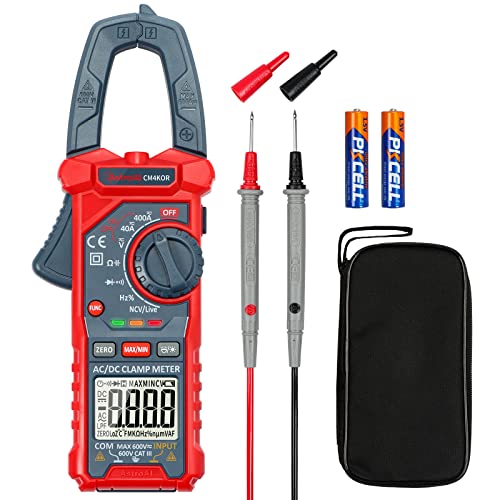
Versatile Digital Clamp Meter: Accurately measures AC/DC Current, AC/DC Voltage, Capacitance, Frequency, Duty Cycle, Resistance, Diode, Continuity and Live Wire Tests. This clamp meter is a really useful tool for solving industrial and household electrical issues.

[1mA Sensitivity]: 1mA sensitivity when measures AC/DC current by clamp.
What True RMS Means for Your Digital Clamp Meter’s Accuracy
True RMS measurement provides the most accurate readings of AC currents with non-ideal waveforms. It calculates the actual heating value of current, rather than relying on the average of a wave shape. Waveform distortion caused by devices like variable frequency drives (VFDs) or switching power supplies creates non-sinusoidal shapes, and True RMS meters handle these better than average-responding meters designed for pure sine waves. A top battery tray can help secure your meter and leads for organized testing. Many users rely on battery tester reviews to find models that maintain accuracy under such distorted conditions. Proper charging of a gel battery also requires a True RMS meter to safely verify the charger’s output under non-sinusoidal conditions.
However, Crest factor plays a critical role in accuracy. Crest factor is the ratio of the peak value to the RMS value of a waveform. A perfect sine wave has a crest factor of 1.414, but distorted waveforms often have crest factors exceeding 2.0. The specifications on your clamp meter will specify the maximum crest factor it can accurately measure, such as 2.5 at full scale. If the waveform’s crest factor exceeds this limit, expect some error in the reading even with a True RMS meter.
Always verify the frequency range listed in the specifications. True RMS accuracy is valid only within a defined bandwidth. Make sure your meter’s frequency range aligns with the load’s operating frequencies to ensure the most reliable readings. Neglecting this can lead to inaccurate measurements, especially in high-frequency switching environments.
Auto-Range, True RMS, and Other Must-Have Clamp Meter Features
Auto-ranging and True RMS are essential features you should look for on mid-range and professional digital clamp meters. Auto-ranging automatically selects the appropriate measurement range, which speeds up routine checks and reduces user error. A manual RANGE button can still be useful for fixed-range measurements or troubleshooting specific scenarios. True RMS measurement is crucial when dealing with non-linear loads, as it provides accurate readings on AC current and AC/DC voltage. When assembling your own solar panel system, you will need a clamp meter that can measure the DC current output from individual panels to verify your wiring layout matches the planned configuration.
Additional useful features include non-contact voltage detection (NCV), which helps identify live wires safely without contact, and LoZ (Low Impedance) mode, which eliminates ghost voltages caused by static or induced electricity. A high-contrast LCD with at least 6000 counts enhances readability in tight or poorly lit spaces. Battery life is extended with auto power-off, preventing unnecessary drain, while regular calibration ensures long-term measurement accuracy. Proper maintenance and periodic verification of your meter’s specs are key to maintaining reliable readings over time. For roof-mounted solar installations, knowing the panel mount compatibility ensures your meter’s clamp can safely fit around the wiring without interference. When sizing panels for power output, understanding the best solar panels for small homes helps you select a clamp meter with appropriate AC current capacity.

True-RMS clamp meter: This multimeter can accurately measure AC/DC Current, AC/DC Voltage, Frequency or Duty Cycle, Resistance, Capacitance and also provides Diode, Continuity and Temperature tests. True RMS for accurate measurements on non-linear loads. Easy to use for labs factories and household

[1mA Sensitivity]: 1mA sensitivity when measures AC/DC current by clamp.

VERSATILE CLAMP METER: Measures AC current and NCVT via clamp; AC/DC voltage, resistance, and continuity via test-leads; temperature via thermocouple
Accuracy on Low vs. High Current: What to Expect
Accuracy varies significantly depending on the current level you’re measuring. Measurements at low current levels, typically below about 10% of the meter’s full scale, tend to be less reliable. Errors can surpass 10%, making precise readings difficult. Magnetic interference and offset drift—caused by slight movements or environmental factors—especially impact DC low-current measurements. For more accurate results, use a dedicated low-current range or wrap the conductor multiple times around the clamp to amplify the signal. For diagnosing parasitic battery drains on vehicles, a meter with 1mA resolution down to 60A is essential for catching the tiny currents that cause batteries to die overnight. This is similar to how a tripping breaker box can indicate a persistent low-level fault that drains circuit stability. For larger backup power needs, a solar generator can provide reliable off-grid current.
High current measurements, on the other hand, are generally much more dependable. In this range, your clamp meter usually delivers accuracy within ±2 to 3% of the reading, providing stable and repeatable results. Avoid using the highest range — for example, a 600A setting for measuring 5A loads — because accuracy drops near the range’s lower limit. Instead, select a higher, more appropriate range that matches your load to get consistent results. For very small currents, it’s often better to bypass the clamp and use a series multimeter designed for low-current testing.
Why Professional Clamp Meters Have Safer CAT Ratings
Professional clamp meters prioritize safer CAT ratings over raw voltage numbers because a transient overvoltage spike can far exceed a meter’s steady-state maximum voltage. The CAT ratings from IEC 61010 specify the measurement safety level based on potential arc flash and fault energy, not just the voltage they can handle. For example, a CAT III 1000 V or CAT IV 600 V rating indicates the meter’s ability to withstand sudden voltage surges without compromising safety. To maintain safety integrity, test leads and accessories must have matching or higher CAT ratings; cracked or lower-rated insulation on leads can create dangerous failure points. Just as with a solar panel kit, choosing equipment with the right safety certifications ensures reliable protection against electrical hazards. Safety labels on the meter and its accessories confirm independent lab certification. Proper calibration of the clamp meter also ensures that its protective features provide consistent safety. An interlock kit for your generator similarly relies on certified components to prevent dangerous backfeeding and arc flash events. Ultimately, a high CAT rating represents a system-level safety measure, not just a voltage limit, helping you work confidently near distribution equipment and service entrances.
Common Mistakes to Avoid When Using a Clamp Meter
Even a high-quality professional clamp meter won’t prevent common user errors. First, never clamp more than one conductor at a time. Magnetic fields cancel out, leading to zero or false readings. Always isolate a single wire inside the jaw to ensure accuracy. Second, verify that you select the correct measurement mode before testing. Using an AC-only meter on DC measurements or switching to voltage mode while measuring current can cause damage or short circuits. Third, position the conductor so it is centered in the jaw; misalignment reduces measurement precision. Fourth, always zero the meter before taking DC measurements to eliminate residual offsets. Ignoring this step can result in inaccurate readings. Calibration drifts over time, so regular zeroing is essential. Lastly, observe safety precautions: never exceed the specified current or voltage limits of your meter, and avoid testing in wet or hazardous environments. Overloading the meter can damage internal components and increase shock risks.
How to Choose a Digital Clamp Meter That Avoids These Mistakes
Choose a digital clamp meter with a CAT rating appropriate for your highest-risk installation area. For panel work, a minimum of CAT III 600 V is recommended to ensure safety from potential voltage transients. Match the meter’s current range with a margin above your maximum load; this prevents overload and measurement inaccuracies. Verify that the meter supports True RMS measurement if you frequently work with nonlinear waveforms, as this ensures accurate readings in complex electrical environments. Check the jaw size against your largest conductor bundle to ensure it can clamp securely without damaging wires or providing incomplete measurements. Prioritize models with built-in functions like inrush current measurement or low impedance (LoZ) mode, which can often eliminate the need for adapters or additional tools. Confirm that the battery type is reliable and easily replaceable to avoid field downtime. Review the manufacturer’s recommended maintenance procedures to maintain long-term accuracy and reliability. Always compare safety certifications, such as UL or IEC standards, rather than choosing based purely on price. Avoid inexpensive models lacking the appropriate CAT rating or measurement range, as they compromise safety and accuracy. Remember, you are selecting a precision tool designed for safety, not gambling on a cheap, risky alternative.

True RMS Accuracy for AC/DC Current & Voltage: Features True RMS technology for precise measurements of both linear and non-linear loads. Measures AC/DC current up to 600A and AC/DC voltage up to 1000V, ideal for motor controls, HVAC systems, and industrial maintenance.

Accurate Measurements: Our T-RMS Digital clamp meter offers precise measurements of 4V~600V AC/DC voltage, 1A~600A AC current, capacitance, resistance, temperature, diode, continuity, NCV, and more, Ideal for automotive, home, and industrial electrical troubleshooting

UL Certified CAT IV 600 CAT III 1000V, measures 0-600 Amps AC/DC and 0-1000 Volts AC/DC, Over molded industrial design enhances gripping and allows the multimeter to withstand a 6.6-foot (2 m) drop