

Imagine this: you’re three days into a backcountry hike, your phone’s at 5%, and you’ve got no power bank left. That’s exactly when a battery-free solar charger becomes your best friend. These three models, the Anker 21W, BigBlue 28W, and Renogy 100W, skip the internal battery entirely. Instead, they feed sunlight straight to your device, keeping weight low and efficiency high. You’ll want to know which fits your pack best, and how to pick one without getting tangled in specs.
| SOLPERK Solar Panel Kit 20W 12V Solar Battery Charger Maintainer+Controller |  | Best Overall | Wattage: 20W | Controller Type: MPPT | Supported Battery Types: LiFePO₄, Lithium Ion, AGM, SLA, GEL, EFB, MF | VIEW LATEST PRICE | Read Our Analysis |
| POWOXI 7.5W 12V Solar Battery Charger Trickle Maintainer Kit for Car | 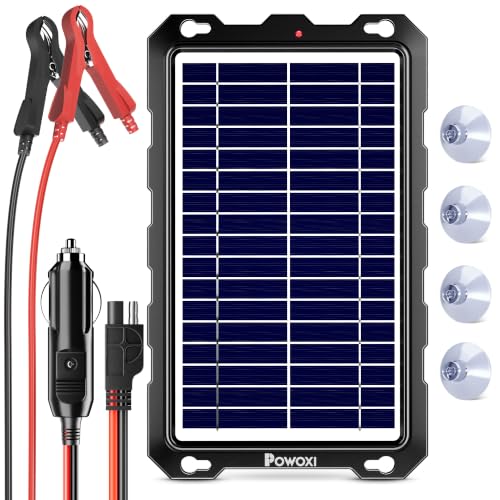 | Budget-Friendly Pick | Wattage: 7.5W | Controller Type: Intelligent charge controller (non-MPPT) | Supported Battery Types: LiFePO₄, Lithium Ion, and general 12V types | VIEW LATEST PRICE | Read Our Analysis |
| Voltset 20W 12V Solar Panel Battery Charger Trickle Maintainer Kit | 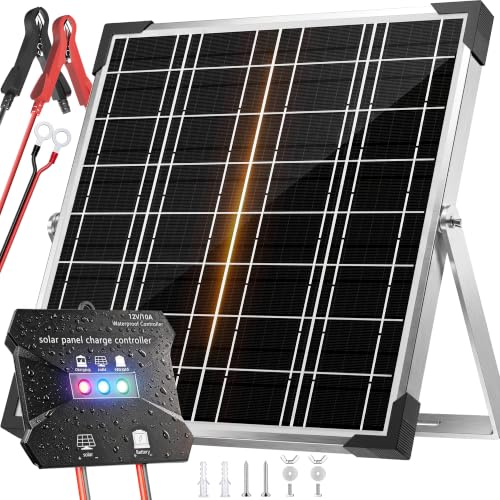 | Top Performance | Wattage: 20W | Controller Type: MPPT | Supported Battery Types: LiFePO₄, AGM, Gel, Flooded, Lithium Ion | VIEW LATEST PRICE | Read Our Analysis |
More Details on Our Top Picks
SOLPERK Solar Panel Kit 20W 12V Solar Battery Charger Maintainer+Controller
If you want a no-fuss solar setup that just works, the SOLPERK Solar Panel Kit 20W 12V Solar Battery Charger Maintainer+Controller takes the crown. You’re getting a 20-watt monocrystalline panel with an intelligent MPPT controller that boosts charging by 20-30%. It handles LiFePO₄, Lithium Ion, AGM, SLA, and GEL batteries flawlessly.
The panel shrugs off harsh weather, tolerating 2400Pa wind and 5400Pa snow loads. Plus, that 360-degree adjustable bracket lets you chase the sun. Installation is plug-and-play with pre-drilled holes and simple cable connections. The three-stage charging prevents overcharging, and idle mode drains zero power. You’ve got one-year service and lifetime tech support backing it up.
- Wattage:20W
- Controller Type:MPPT
- Supported Battery Types:LiFePO₄, Lithium Ion, AGM, SLA, GEL, EFB, MF
- Panel Material:A+ monocrystalline silicon, aluminum frame, tempered glass
- Protection Features:Overcharge, over-voltage, short circuit
- Weight:~3 lbs
- Additional Feature:360-degree adjustable mount
- Additional Feature:Three-stage charging process
- Additional Feature:Pre-drilled mounting holes
POWOXI 7.5W 12V Solar Battery Charger Trickle Maintainer Kit for Car
The POWOXI 7.5W 12V Solar Battery Charger is our budget-friendly pick for anyone who needs a reliable trickle maintainer without breaking the bank. It’s not the biggest panel, but it’s smart: an intelligent controller prevents overvoltage and short circuits, so you won’t fry your car’s battery. That 25-30% efficiency from its silicon cells matters, and the robust ABS+PC frame won’t scratch your paint. Installation is a breeze. You’ve got two options:
- Plug into your cigar lighter socket for a quick hookup.
- Use the alligator clips to connect directly to battery terminals.
And with LED indicators, red means sunlight, green means it’s charging. It works with LiFePO₄ and lithium ion batteries too, for cars, boats, or ATVs. Plus, it’s waterproof and comes with lifetime technical support.
- Wattage:7.5W
- Controller Type:Intelligent charge controller (non-MPPT)
- Supported Battery Types:LiFePO₄, Lithium Ion, and general 12V types
- Panel Material:Monocrystalline silicon, ABS+PC frame, tempered glass
- Protection Features:Overvoltage, short circuit
- Weight:~2.2 lbs
- Additional Feature:Cigarette lighter adapter
- Additional Feature:ABS+PC frame coating
- Additional Feature:0.41A current rating
Voltset 20W 12V Solar Panel Battery Charger Trickle Maintainer Kit
Need to keep a 12V battery healthy without constant babysitting? The Voltset 20W kit is your set it and forget it solution. It packs MPPT tracking for 20-30% faster charging, so your AGM, LiFePO4, or flooded battery stays topped up efficiently. Setup is a breeze with pre-drilled holes giving you a 30 second install. The 10A smart controller automatically stops charging when full and resumes when voltage drops, preventing overcharge damage. And it’s built tough with IP67 waterproofing and a 25 year lifespan, handling temperatures from -40°F to 185°F. No fuss, just reliable maintenance.
- Wattage:20W
- Controller Type:MPPT
- Supported Battery Types:LiFePO₄, AGM, Gel, Flooded, Lithium Ion
- Panel Material:A+ monocrystalline silicon, aluminum frame, tempered glass
- Protection Features:Overcharge, over-discharge, short circuit, reverse polarity
- Weight:Not specified
- Additional Feature:30-second tool-free setup
- Additional Feature:IP67 waterproof construction
- Additional Feature:Auto-resume when voltage drops
Factors to Consider When Choosing a Solar Charger Without Battery

Before you pick any battery-free solar charger, you’ve got to match its power output to what you’ll actually charge, so list your devices’ wattage needs first. Then weigh portability against durability, because a flimsy, foldable panel might be light but won’t survive a dusty trail, while a rugged, weatherproof unit could be a brick in your pack. Finally, check the controller type, PWM for budget tweaks or MPPT for squeezing every drop of sun from your battery chemistry, since that decision quietly decides how fast your gear tops up.
Power Output Needed
Since you’re powering devices directly without a built-in battery buffer, your charger’s power output becomes the critical factor. You need to match it to your devices’ total wattage. A 5W panel works for a single phone, but if you’re charging a laptop or multiple gadgets, you’ll want 20W or more. Higher wattage means faster charging and the ability to run several devices at once.
Calculate your total wattage requirements first. Add up the power needs of everything you’ll plug in. Then choose a charger with slightly higher rated output than that number. Why? Because actual power varies with sunlight. A 30W panel might only deliver 20W on a cloudy day. That extra buffer keeps you from underperformance. And for maintaining batteries without overdrawing current, pick a panel whose output matches your battery’s charging capacity. It’s a simple equation: match your needs, then add a margin for real-world conditions!
Portability and Size
Your power output math is settled, so now let’s talk about what you’ll actually carry. Weight and dimensions matter more than you think. You want a charger that slips into your pack without screaming for space. Look for foldable or compact designs that keep panels efficient without turning into a burden. Smaller sized chargers win for mounting: they’ll stick on a backpack or tent flap with minimal fuss, and you can stash them anywhere.
But don’t just grab the tiniest option. Adjustable stands or mounting points matter too. They let you angle the panel for direct sun without adding chunky extras. A clever kickstand adds no bulk but saves your phone’s battery from sitting in shadow. Larger panels give you more power, but you’ll feel every extra ounce on a long hike. Balance your mobility demands against output. Car camping? Go big. Backpacking? Stay lean and foldable. You’ll thank yourself later.
Battery Chemistry Support
Two key factors determine whether a solar charger works with your battery: chemistry and voltage. You must match the charger to your specific battery type, like LiFePO₄, AGM, or Gel. Mismatching causes trouble: reduced lifespan, overcharging, or even damage. So, check the charger’s settings or capabilities. Some chargers offer multi-chemistry support with automatic detection, which makes your life easier. But don’t rely on that alone. You also need built-in protection against overvoltage and overcurrent tailored to your battery. For example, a LiFePO₄ battery needs a different charging profile than an AGM one. Without that support, you’re risking your gear. So, verify compatibility before you buy. A little research now saves you a headache later. Trust me, your battery will thank you.
Durability and Weatherproofing
Why settle for a charger that can’t handle the elements? You need a solar charger built for real outdoor abuse. Look for weather resistant materials like tempered glass, aluminum frames, or ABS+PC frames; they’ll survive drops, debris, and temperature swings from 40°F to 185°F.
Waterproofing matters too. Aim for an IP67 or IP68 rating, meaning your charger shrugs off rain, splashes, or even accidental submersion. And you want panel specs that laugh at snow loads, wind up to 2400Pa, and hailstones. Impact resistant tempered glass and a sturdy frame prevent cracking during sudden storms or bumps.
Don’t compromise: a durable, weatherproof charger keeps performing in deserts, mountains, or coastal spray without flinching. Choose toughness, and your devices stay powered no matter the forecast.
Controller Type (PWM vs MPPT)
Durability’s a big part of picking a solar charger, but once you’ve got a rugged panel that can handle the elements, you’ve got to think about what’s managing the power flow. You’ll face two main controller types: PWM and MPPT. PWM controllers are simpler and cheaper, perfect for small setups. They gradually reduce power as your battery nears full charge. MPPT controllers, however, are the efficiency champs. They convert 20-30% more energy by matching the panel’s output to your battery’s voltage. If you’re dealing with variable sunlight or a larger system, MPPT is your best bet. For a basic, budget-friendly option, PWM works fine. Think about your system size and how much efficiency you need. For most high-performance needs, MPPT wins.