
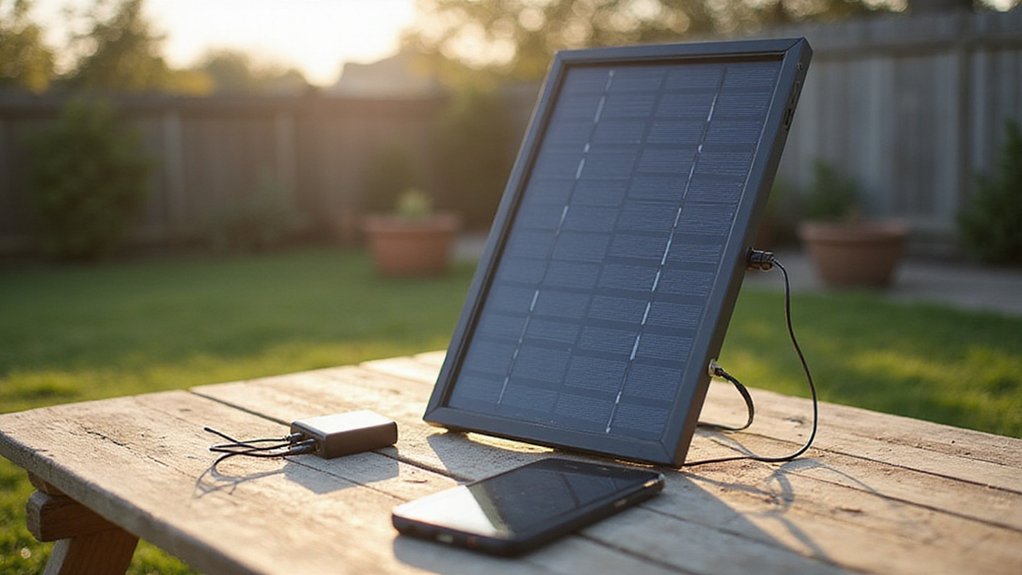

Wondering what a 100-watt solar panel can actually power in real life? It typically provides around 400 to 500 watt-hours per day. That’s enough to charge your smartphone many times or run small devices for a few hours.
But it can’t handle heavy appliances like a fridge or microwave.
Keep reading to see exactly what you can and can’t power with it.
How Many Charges Can a 100W Panel Give Your Phone or Tablet?
A 100W solar panel can realistically give your phone between 10 and 15 charges per sunny day. While it can theoretically produce about 100 watt-hours per hour in direct sunlight, real-world conditions such as heat loss, angle inefficiencies, and conversion losses reduce this amount to around 400–500 watt-hours of usable energy daily. Since a typical smartphone battery needs roughly 10–15Wh for a full charge, this means you could potentially recharge your phone multiple times. However, actual output is seldom this high due to fluctuating sunlight and efficiency issues during USB power conversion. To maximize your energy, it’s best to connect the panel to a battery first, which can store excess power for later use. For optimal performance, look for panels with MC4 connectors to ensure reliable, weather-resistant connections to your battery system. Using a high-quality charge controller can significantly improve energy harvesting by managing voltage and preventing battery damage. Keep in mind that your phone’s battery size and variable sunlight conditions will limit the total number of charges. For tablets, which have larger batteries requiring more energy, the number of recharges you get per day drops significantly, making the panel more suited for slow, steady topping-up rather than full daily recharges. When choosing a panel, small homes often benefit from portable or compact models that balance efficiency with space constraints.

Quick Parallel 2 Solar Panels: BougeRV 1 to 2 Y branch cable can parallel 2 solar panels. The kit includes 1 male to 2 female (M/FF) and 1 female to 2 male (F/MM) solar connectors

Package Included: 6 pairs solar panel connectors Male and Female + 6 pairs solar connector pins (male and female) + 1 pair of spanners
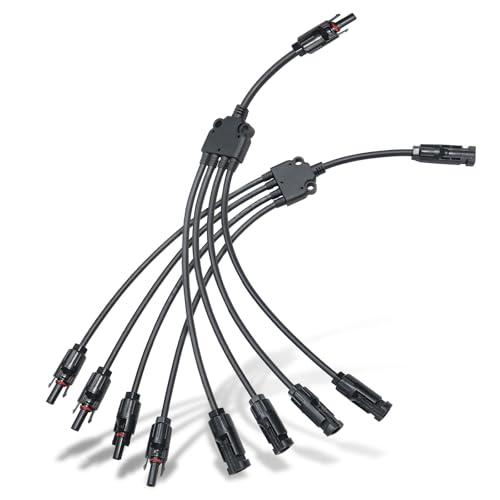
Y Branch Parallel Connector: 1 male to 4 female and 1 female to 4 male solar connectors can connect 4 solar panels in parallel to provide greater power usage
Can a 100W Panel Power a Wi-Fi Router and Laptop for Work?
A 100W solar panel can power a Wi-Fi router and a laptop for work if paired with a battery storage system and energy-efficient devices. Typically, a 100W panel produces about 300–500Wh of electricity per day under good sunlight conditions. A 6W router running continuously for 24 hours consumes around 144Wh, leaving approximately 200–350Wh for your laptop. With a 50W laptop, this allows for roughly 4 to 6 hours of work time, assuming minimal power use during heavier tasks or video calls. For those seeking the best performance, using a smart plug with energy monitoring can help you precisely track and reduce your devices’ real-time power consumption to stay within your solar budget.
To ensure reliable operation, choosing low-power devices is crucial: select a router under 15W and a low-power laptop in the 30–60W range. Without a battery or portable power station, power interruptions caused by clouds or dusk will interrupt your work. Incorporating a 12V battery or portable power station helps store excess energy and supplies power during low sunlight hours. For a reliable setup, you should consider top battery picks with terminals that emphasize quality and performance to minimize energy loss. Using an inverter to convert stored DC power to AC adds about 10–15% energy loss, so efficiency matters. Keeping workloads moderate and energy consumption low maximizes how long you can work effectively on a 100W solar setup. To prevent performance drops over time, regularly inspect connections for corrosion from oxidation, which increases resistance and reduces the flow of stored power to your devices.

Efficient Output: This portable power station features 8 output ports, including 2 AC sockets (110V 120W, 240W peak), 1 USB-C port (18W), 2 QC 3.0 USB ports, 1 USB port (5V 2.4A), and 2 DC ports (12V/10A). The LED display clearly shows the working status and remaining power. Ideal for camping and outdoor adventures, this camping power bank can power devices like night lights , mini fans, and below 120W other essential equipment, making it a reliable companion for your trips
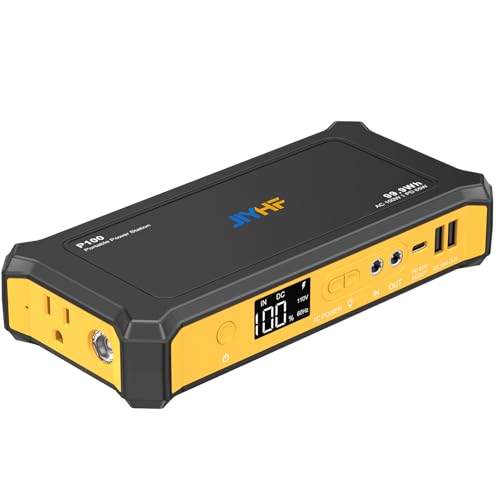
FLY WITH IT — 99.9Wh(27000mah at 3.7v, 9000mah at 11.1v) is under the 100Wh FAA & airline carry-on limit. No airline approval needed. TSA-friendly for flights and road trips

UPGRADED PORTABLE POWER: As from the last upgrading, this portable power station of MARBERO is called M822 which is another same outfit design as the MARBERO M82. This brand new battery generator has an even more powerful capacity of 146Wh(equiv. 40,000mAh/3.7V) and much more power output of 200W, which can support more usage situations and more appliances with a convenient small size(7.5*5.3*3.6 in, 3.3 lbs) but a more powerful inside.
What Lighting and Fans Can a 100W Panel Realistically Run?
A 100W solar panel can realistically power a small combination of LED lights and fans during peak sunlight hours. For example, running one 12W LED light along with a 15W DC fan results in a daytime load of about 27W. Since real-world output often peaks around 70 to 80W, staying under a 50W draw without battery storage provides a safe margin for continuous operation. Adding battery storage allows for reliable evening lighting and compensates for cloudy periods or shifting panel angles. Understanding inverter generator capabilities can help frame how these small solar loads compare to portable power solutions for backup needs, and reviewing the best costs for solar equipment helps ensure you choose an efficient and affordable setup. A critical step in any permanent solar installation involves proper grounding connections to meet code requirements and prevent electrical hazards. Using a 30W camping fan with a 10W LED strip creates a balanced 40W load, which comfortably fits within the panel’s typical daily energy yield of 350 to 500Wh. Optimizing panel orientation throughout the day maximizes energy collection and supports these modest but useful loads effectively.

Bright Interior Lighting: Lights up the cabin, bunk, galley, or hallway with clean, even ight; bunk-style unit stands nearly 10 inches tall
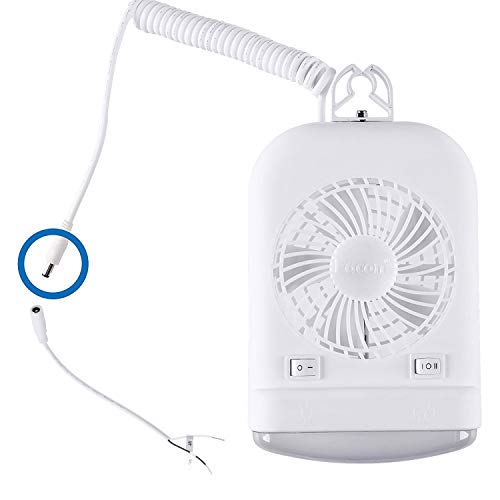
【Pop Up Style】Comes with 1/5''(5.5mm) Male Plug and Combo-Bunk Clip was designed for Pop Up RV Campers. Add Light and Improve Air Circulation with this Fan Light Combo. Perfect for the Bunk Area of Your RV.

✅WIDE APPLIED IN 12VOLT DC APPLICATION: This compact camper fan and light combo is designed for 12volt DC low voltage interior applications, such as RV, travel trailer, camper, pop up, 5th wheel, boat, etc.
Can a 100W Panel, With a Battery, Run a Mini Fridge or CPAP?
Running a mini fridge or CPAP with a 100W solar panel and battery storage is possible, but with limitations. A mini fridge averaging 75W will quickly drain a typical battery, especially considering its startup surge of 200–400W, which can overload small systems. If you have a 100Ah battery, it might power the fridge for around 20 hours, but you won’t be able to fully recharge the battery in one day if your daily consumption exceeds 300–400Wh. Intermittent use or limiting the fridge’s runtime is necessary to avoid deep discharging the battery and damaging it.
A CPAP device without a humidifier is far more practical for this setup. These machines typically draw 20–30W, translating to about 120–250Wh consumed overnight. An energy system with a 100W panel can recharge a 500Wh battery in one to two sunny days, providing reliable nightly power for a CPAP. Steady, low-energy devices like a CPAP fit better in a small solar-battery system, while high-energy appliances like a mini fridge strain your system’s capacity and should be used sparingly.

【High-Efficiency MPPT Controller】This advanced MPPT charge controller providing over 30% additional power compared to standard solar charge controllers. This fully waterproof MPPT controller can be completely submerged in water. It offers comprehensive protection for your battery, safeguarding against overcharging, deep discharging, excessive voltage, current surges, overloads, short circuits, reverse polarity, and overheating

High-Efficiency Monocrystalline Silicon: The 100W solar panel uses premium monocrystalline silicon cells, providing up to 30% higher efficiency than ordinary silicon, ensuring maximum power output even in low-light environments

【Efficient Performance】This Starter Kit can generate an average of 500Wh of electricity per day (varies with sunlight). The solar panel boasts a 22.5% cell efficiency, 1.3% higher than other counterparts. Each panel dispatched from our facility undergoes 100% EL testing, ensuring that your panel is completely free from any hidden cracks.
What Devices a 100W Panel Should Never Be Expected to Power
What can a 100W solar panel power might never include devices that require a sudden, high startup surge, much like how removing the negative battery cable first. A 100W solar panel should never be expected to power resistive heating devices, high startup surge appliances, or sustained high-wattage loads. Resistive heaters like space heaters, electric kettles, and toasters typically require 1,000 to 1,500W, which far exceeds what a small solar panel can sustainably provide, especially during startup. Microwaves fall into a similar range, needing 700 to 1,500W and experiencing power spikes at startup that can trip small inverters or drain batteries quickly.
Additionally, a 100W panel cannot run appliances with continuous high power consumption such as full-size air conditioners, clothes dryers, or powerful power tools like table saws and air compressors. These devices draw hundreds of watts steadily or surge to even higher wattages during startup, making them impractical for a small solar setup. To avoid draining your batteries or tripping breakers, stay within loads that are well below the panel’s daily energy yield, which is typically between 300 and 600Wh in good sunlight. Focus instead on low-power electronics and small appliances that match the panel’s capacity.