

Did you know a typical window AC unit can guzzle over 1,200 watts an hour during peak heat? That’s a serious drain on your wallet and the grid, especially when summer hits its stride. But you don’t have to sweat the electric bill or worry about blackouts. You just need the right solar setup. Let’s walk through six panels built to handle that load, from portable bifacial options to complete off grid kits.
| [Ultra]ECO-WORTHY 12V 400W Complete Solar Panel Kit for RV Off Grid Trailer | ECO-WORTHY 12V 400W Complete Solar Panel Kit for RV Off Grid Trailer”] | Best Complete Kit | Maximum Power Output: 400W (4 x 100W panels) | Cell Efficiency: Not specified | Cell Material: Monocrystalline silicon | VIEW LATEST PRICE | Read Our Analysis |
| Jackery SolarSaga 40W Air Solar Panel,Bifacial | Best Ultra-Portable | Maximum Power Output: 40W | Cell Efficiency: 23% (PERC cells) | Cell Material: Monocrystalline silicon (PERC) | VIEW LATEST PRICE | Read Our Analysis | |
| RENOGY REGO 200 Watt Portable Solar Panel N-Type 25% High Efficiency |  | Best Lightweight Power | Maximum Power Output: 200W | Cell Efficiency: 25% (N-type cells) | Cell Material: N-type monocrystalline silicon | VIEW LATEST PRICE | Read Our Analysis |
| EBL 200W Portable Solar Panel High Efficiency Solar Power Panel | 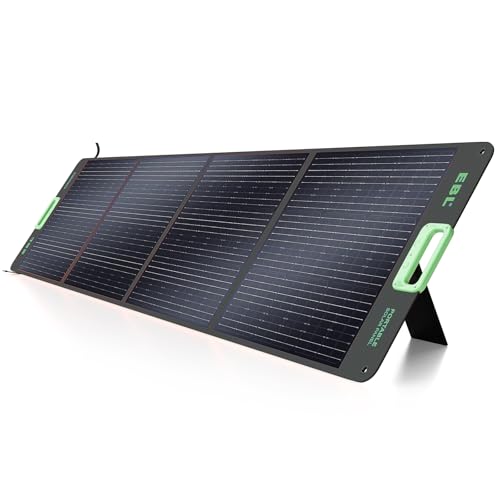 | Best Budget 200W | Maximum Power Output: 200W | Cell Efficiency: Not specified (high-efficiency monocrystalline) | Cell Material: Monocrystalline silicon | VIEW LATEST PRICE | Read Our Analysis |
| RENOGY REGO 200 Watt Solar Panel N-Type 25% High Efficiency Solar Panel | 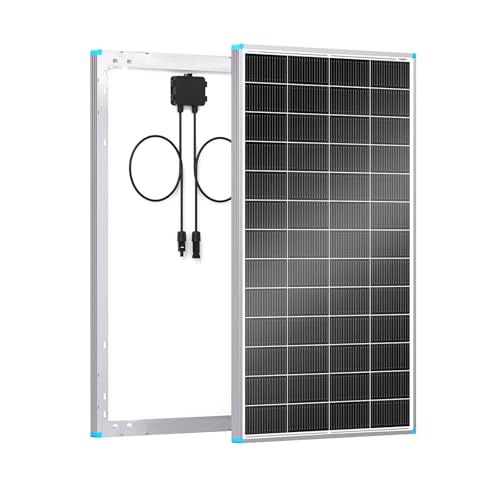 | Most Durable | Maximum Power Output: 200W | Cell Efficiency: 25% (N-type cells) | Cell Material: N-type monocrystalline silicon | VIEW LATEST PRICE | Read Our Analysis |
| ECO-Worthy 1.6KWH Complete Solar Panel Kit 400W 12V for RV Off Grid |  | Best All-in-One | Maximum Power Output: 400W (4 x 100W panels) | Cell Efficiency: 23% (bifacial cells) | Cell Material: Bifacial monocrystalline silicon | VIEW LATEST PRICE | Read Our Analysis |
More Details on Our Top Picks
[Ultra]ECO-WORTHY 12V 400W Complete Solar Panel Kit for RV Off Grid Trailer
ECO-WORTHY 12V 400W Complete Solar Panel Kit for RV Off Grid Trailer”]Best Complete Kit
View Latest PriceIf you want to power your RV this summer without piecing together a puzzle, this Eco-Worthy 12V 400W kit is the complete package. You get four 100W monocrystalline panels, a 280Ah lithium battery, a 2000W inverter, and a 40A MPPT charge controller. It delivers 1600Wh daily and stores 3.5kWh, so your AC stays on. Installation takes five simple steps, perfect for beginners. And the manufacturer offers 24/7 support if you hit a snag. With a 4.2-star rating, this kit gives you reliable off-grid power without the hassle.
- Maximum Power Output:400W (4 x 100W panels)
- Cell Efficiency:Not specified
- Cell Material:Monocrystalline silicon
- Frame Material:Aluminum
- Weatherproof Rating:Not specified (tempered glass)
- Output Voltage:12V DC
- Additional Feature:Daily 1600Wh power generation
- Additional Feature:3.5kWh battery storage capacity
- Additional Feature:Five-step connection process
Jackery SolarSaga 40W Air Solar Panel,Bifacial
You hunt for a panel that won’t weigh you down. The Jackery SolarSaga 40W Air Solar Panel tips the scales at just 1.98 lbs, so you barely feel it in your pack. Its bifacial design captures sunlight from both sides, pumping out up to 40W even on cloudy days. Plus, advanced PERC cells hit 23% efficiency. You get:
- IP68 waterproof and dustproof rating for rain or dust.
- 4,000 fold tested durability.
- Dual USB ports for charging phones, lights, and small devices.
W-Fold it into a book sized bundle, clip carabiners to your tent, and you’re ready for off grid power. No heavy lifting needed.
- Maximum Power Output:40W
- Cell Efficiency:23% (PERC cells)
- Cell Material:Monocrystalline silicon (PERC)
- Frame Material:Aluminum
- Weatherproof Rating:IP68
- Output Voltage:5V (via USB)
- Additional Feature:Bifacial sunlight capture
- Additional Feature:IP68 waterproof/dustproof rating
- Additional Feature:W-fold book-sized design
RENOGY REGO 200 Watt Portable Solar Panel N-Type 25% High Efficiency
Summer’s relentless sun demands a portable solar panel that’s lightweight and powerful. You’ll love the RENOGY REGO 200W. It weighs just 8.82 lbs, thanks to patented 8 fold compression, making it 54% lighter than comparable systems. Plus, it’s 56% smaller, easily fitting into a backpack. Those N type monocrystalline cells hit 25% efficiency, and the 16BB technology keeps charging fast even in extreme heat. For setup, you can unfold it on your RV, ground, or hang it in a sunny spot. It’s IP65 rated, so rain won’t stop you. Just plug in your power station or devices via the USB C and USB A ports.
- Maximum Power Output:200W
- Cell Efficiency:25% (N-type cells)
- Cell Material:N-type monocrystalline silicon
- Frame Material:ETFE-laminated case
- Weatherproof Rating:IP65
- Output Voltage:5V (via USB)
- Additional Feature:8-fold compression design
- Additional Feature:Patented 16BB technology
- Additional Feature:ETFE-laminated case
EBL 200W Portable Solar Panel High Efficiency Solar Power Panel
Portable solar charging doesn’t have to break the bank, and the EBL 200W panel proves it. You get high efficiency monocrystalline silicon cells that pump out steady 200W for your batteries, appliances, or devices. It’s built tough with tempered glass and aluminum, so rain or snow won’t stop you. Plus, you’ll love the built in protections against overcharging and short circuits.
Here’s what makes it easy:
- Pre-drilled holes for quick setup
- Compatible with most charge controllers
At 23.2 by 22.7 inches, it’s a solid choice for your RV, camping rig, or home backup. And with a 4.4 star rating, it’s a smart pickup.
- Maximum Power Output:200W
- Cell Efficiency:Not specified (high-efficiency monocrystalline)
- Cell Material:Monocrystalline silicon
- Frame Material:Aluminum
- Weatherproof Rating:Weatherproof (rain, snow, high winds)
- Output Voltage:Not specified (compatible with 12V systems)
- Additional Feature:Pre-drilled holes for mounting
- Additional Feature:Overcharge/short-circuit protection
- Additional Feature:Weatherproof against rain/snow
RENOGY REGO 200 Watt Solar Panel N-Type 25% High Efficiency Solar Panel
For serious off-grid setups, the RENOGY REGO 200W panel is your most durable choice. It boasts a 25% efficiency rate, thanks to its Grade A+ N-type cells and 16BB technology. That means you’ll get about 20W more power than standard PERC panels, even in partial shade. And its temperature coefficient is just -0.29%/°C, so it loses minimal power in scorching summer heat. It’s also built tough: IP67 waterproof, tempered glass, and a rust-resistant frame. You’ll appreciate the compact size, 11.7% smaller and 7.5% lighter than comparable panels, yet it still delivers 200W at 24V. Quick installation is a breeze with pre-drilled holes. Plus, you get a 10-year warranty and a 25-year power output guarantee.
- Maximum Power Output:200W
- Cell Efficiency:25% (N-type cells)
- Cell Material:N-type monocrystalline silicon
- Frame Material:Aluminum
- Weatherproof Rating:IP67
- Output Voltage:24V
- Additional Feature:25-year 80% efficiency retention
- Additional Feature:-0.29%/℃ temperature coefficient
- Additional Feature:Reduces hot spots/micro-cracks
ECO-Worthy 1.6KWH Complete Solar Panel Kit 400W 12V for RV Off Grid
You’re setting up an RV for summer off grid, and this ECO-Worthy 1.6KWH kit is the all-in-one package you’ll want. It pumps out about 1.6KWH daily under four hours of sun, enough to run your AC, fridge, or TV (under 2000W rated power). The four bifacial panels grab light from both sides, boosting efficiency to 23%, and you can adjust the mounts for up to 20% more juice.
Here’s what’s inside:
- Four 100W bifacial panels with 12BB cells for solid energy capture.
- 40A MPPT charge controller that tracks at 99% efficiency.
- 2000W pure sine wave inverter for clean AC power.
- Two 12V 100Ah lithium batteries with built-in BMS, lasting over 3000 cycles.
- Bluetooth 5.0 for remote monitoring from your phone.
And that dual-axis tracker adds up to 40% more output. It’s durable too, with aluminum frames and tempered glass tested up to 85°C. A reliable, complete setup for your summer adventures!
- Maximum Power Output:400W (4 x 100W panels)
- Cell Efficiency:23% (bifacial cells)
- Cell Material:Bifacial monocrystalline silicon
- Frame Material:Aluminum
- Weatherproof Rating:Not specified (tempered glass)
- Output Voltage:12V
- Additional Feature:Dual-axis solar tracker boost
- Additional Feature:Bluetooth Module 5.0 monitoring
- Additional Feature:3000+ deep cycle battery life
Factors to Consider When Choosing Solar Panels for Air Conditioner
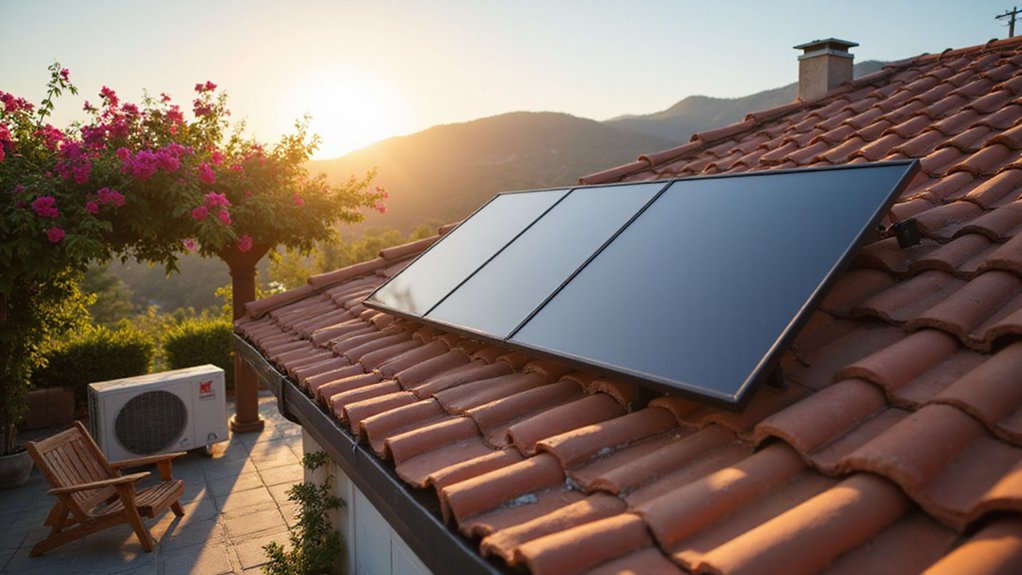
When you’re picking solar panels to run your air conditioner, start with your power output needs. You need enough wattage to handle the AC’s startup surge and continuous draw, so check its specs. Then, look at efficiency ratings, system voltage, and portability, plus durability and weather resistance to guarantee your setup lasts all summer.
Power Output Needs
How much power does your air conditioner actually need? You’ll first check its wattage, usually listed on the unit or in the manual. That number tells you the continuous power required to run it. But here’s the kicker: your AC demands a higher surge wattage at startup, sometimes double or triple the running watts. So you need solar panels whose maximum output handles both the steady draw and that initial spike.
Next, match the panel’s wattage rating to your AC’s needs. A 1,500-watt unit, for example, pairs well with panels producing at least that much under peak sun. And think about duration: calculate total watt-hours for your daily usage. For instance, running a 1,500-watt AC for 6 hours means you need 9,000 watt-hours from your panels daily. So choose a system that delivers consistent power without faltering during peak loads!
Efficiency Ratings
Once you’ve sized your system to handle your AC’s power needs, the next factor to weigh is efficiency rating. This number tells you how much sunlight your panels convert into electricity. For air conditioners, aim for panels with 20% or higher efficiency. You get more power from less roof space, a real win when area is tight.
But don’t stop there. Temperature, shading, and panel orientation can drop that rating fast. Bifacial and N-type monocrystalline panels often beat traditional P-type ones in real world conditions. Here’s what matters most:
- Higher efficiency: More kilowatts for your AC.
- Durability: Resist heat and wear.
- Temperature coefficient: Stays strong on scorching days.
An efficiency rating alone won’t cut it. Pair it with other specs to keep your AC humming all summer.
System Voltage
Before you lock in any panel, think about system voltage. Your air conditioner likely runs on 120V or 240V AC, so your solar setup must convert DC to those exact levels. Mismatch voltage and you risk underperformance or a total shutdown. For off-grid systems, higher voltage like 24V or 48V is your friend. It cuts energy loss over long wire runs, keeping your AC humming efficiently. Your solar charge controller and inverter must match this voltage too. They optimize the power conversion and prevent damage. So, you’ve got three main voltage specs to check: your panel’s, your battery bank’s, and your inverter’s. Get them aligned, and you’ll maximize every sunbeam without the headache of fried components!
Portability and Setup
Why shouldn’t your solar panels be as easy to move as your cooler? Go for lightweight, compact designs like foldable or bifacial panels. They make transport and setup a breeze in any outdoor spot. Look for features like pre-drilled holes, mounting options, or integrated handles. These simplify installation and boost portability.
Check the panel’s dimensions and weight against your vehicle or deployment space. Avoid handling headaches. Choose portable panels with quick-connect wiring and versatile mounting accessories. You’ll set up faster and adjust easily to catch the best sunlight.
For hassle-free moves, prioritize high durability ratings and weatherproof features. They keep performance solid during transport and outdoor use. Aim for panels that deliver power without the struggle. Your AC will thank you!
Durability and Weather
Since your AC unit demands consistent power even when the sun’s blazing, you can’t afford panels that wilt under heat or crack in a storm. So, look for a high IP rating, at least IP65. That dusty, rainy, or snowy weather won’t bother them. Durable tempered glass and aluminum frameworks are key, they take the brunt of hail and heavy winds without breaking. And don’t ignore the temperature coefficient. A low number means the panel loses less efficiency when it’s scorching hot, keeping your AC fed. Reinforced construction with waterproof seals also fights moisture and snow buildup. Finally, certifications like IEC TS 63163 confirm lasting endurance. Pick panels built like tanks, and your cooling stays reliable all summer.
Warranty and Support
Once you’ve got panels built to survive the elements, you’ll want to make sure the company stands behind them for the long haul. Look for an all-encompassing warranty covering at least 10 years for performance and material defects. You also need protection against environmental damages like hail, snow, and water ingress. Power output matters too: the guarantee should promise at least 80% efficiency after 25 years.
And don’t overlook support services. Verify they offer quick technical assistance and troubleshooting. Check for responsive customer channels like phone, email, or live chat. These help you resolve installation or operational hiccups fast. A solid warranty and support team ensure your AC keeps running all summer without a hitch. Choose wisely, and you’ll stay cool for decades!