


Are you trying to decide between MC cable and conduit for your wiring project? The best choice depends on whether you prioritize speed and cost savings or environmental protection and future access.
MC cable can cut installation time by up to 50% and comes ready to go with a dedicated ground, making it a quick, code-compliant option.
Conduit, on the other hand, offers long-term durability in harsh conditions and better protection against damage.
Let’s explore which option fits your needs best.
What’s the Real Difference Between MC Cable and Conduit?
MC cable and conduit are two distinct wiring systems with different construction and installation methods. MC cable comes as a factory-assembled unit with insulated conductors and a dedicated grounding conductor inside a continuous metal armor sheath. Conduit, on the other hand, is an empty raceway that you install first and then pull individual wires through on site. For solar installations, many panels come with MC4 connectors that simplify the connection to MC cable or conduit systems. Cable glands provide a crucial seal where the cable enters enclosures, preventing moisture and dust ingress, making them essential for weatherproof terminations in both systems.
This fundamental difference influences code compliance and safety features. MC cable’s metal armor provides inherent mechanical protection and a reliable equipment ground path, fulfilling Article 330 requirements without requiring additional field assembly. Conduit systems like EMT or RMC depend on the raceway itself for grounding, which requires precise bonding and coupling to ensure a proper fault-clearing path.
You cannot swap one for the other because each serves specific needs. Choose MC cable when integrated protection and simplified installation are priorities, such as in fire-rated assemblies. Opt for conduit when future flexibility, easy upgrades, or multi-purpose pathways are necessary, since it allows adding or changing wires later. Similar to how top battery picks are compared on quality, performance, and value, MC cable and conduit each offer distinct trade-offs that buyers must weigh for their specific project requirements.

Complete Accessories:3/4 liquid tight conduit, 25 ft flexible electrical conduit with 5 straight and 3 90-degree conduit connector fittings.Flexible electrical conduit length:25ft,,Id:0.813inch(20.6mm,Od:1.03 inch(26.4mm),thick: 2.5mm,fittings install directly onto conduit for waterproof joints

Product Overview: Split sleeve master kit includes 5 different diameter wire loom split sleeve, along with fabric heat shrink tubing, silicone tape, locking bands, and wire tape. It fully meets the cable management and protection requirements in professional installation scenarios.

Liquid Tight Conduit Kit: Our liquid-tight conduits are made of antioxidant PVC material, featuring a smooth interior for easier wire pulling. Length: 25 feet, Comes with 4 straight and 3 90-degree conduit connectors
Which Option Saves More Time on Installation?
MC cable saves more time on installation than rigid conduit, reducing installation time by approximately 30% to 50%. Because MC cable combines conductors and armor into a single preassembled unit, you eliminate the need for separate conduit bending, threading, and conductor pulling. This streamlines a typical 14-step process down to just five steps per run. Labor charts show that MC cable can be installed in about 3.0 to 3.5 hours per 100 feet, compared to 9.0 to 17.0 hours for rigid conduit. This significant time saving allows your crew to work faster, especially on repetitive branch runs. Additionally, the armor provides integral support through studs and joists, making installation more straightforward without sacrificing structural stability. Fire safety requirements are met because MC cable is listed for both exposed and concealed locations, eliminating the need for extra sleeving. For jobs where speed is essential, choosing MC cable can help you move forward more efficiently. However, if your installation also requires grounding the system, be sure to follow the breeder box grounding procedures outlined in a dedicated guide for a clean, reliable result. For reference, the same principle of disconnecting the negative terminal first during battery work minimizes the risk of accidental short circuits. When connecting to a main panel, always verify that the subpanel feeder breaker is properly sized to match the cable ampacity.
How Do MC Cable and Conduit Costs Compare Installed?
MC cable generally has lower installed costs than conduit for branch circuits because labor expenses dominate. For example, running 1,980 linear feet of 12/2 MC costs about $8,316, while the same length of EMT conduit with wire reaches $14,058—a 41 percent savings with MC. This cost advantage stems from MC cable’s handling speed and fewer required accessories since you do not need to bend pipe or pull conductors separately. Although conduit material, fittings, and additional labor raise overall costs, MC’s flexible nature results in faster, more efficient installations. Even if MC material costs more per foot than EMT plus wire, the total installed cost typically remains lower. For feeders, installing 4/0 MC at roughly $661.20 beats using 3-inch galvanized conduit at about $2,888.40 with the same labor rate. When comparing these options, remember that quality and performance reviews of top power inverters can help buyers choose the best value for their specific needs. For standard branch circuits, sticking with MC helps keep your project on budget. For those seeking the most efficient connection methods, reviewing the top terminal blocks for DIN rail can further reduce installation time and costs. However, as with electrical work, attempting to revive dead batteries can be a temporary fix with significant safety risks.

Product Specification: 12 AWG heavy duty metal cable 50ft with 3 solid cooper wires: 2 current-carrying wires and 1 ground wire; maximum temperature: dry 90℃/wet 75℃; voltage rating: 600V; UL listed

Conductor Size: 12
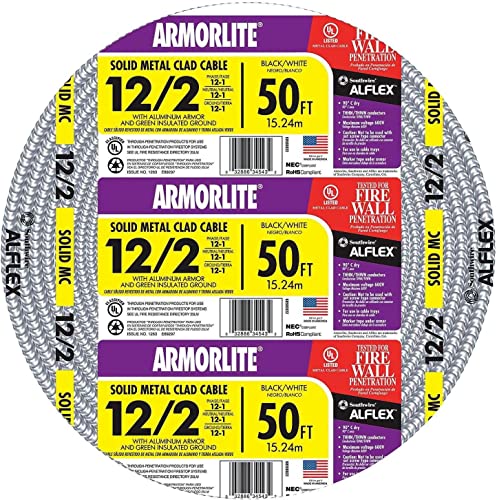
Conductors are made with soft drawn copper.
When Is Conduit Worth the Extra Cost for Protection?
Conduit is worth the extra cost for protection whenever your wiring faces exposure to physical damage, moisture, chemicals, or code-mandated safeguards. In garages, workshops, or warehouses, physical damage risk demands rigid metal conduit or electrical metallic tubing (EMT) for mechanical strength—metal conduit is often required because non-metallic options like MC cable cannot pass code in these environments. For wet basements or outdoor runs, PVC or liquidtight conduit effectively guards against moisture and ultraviolet light, while sealed raceways in industrial settings resist corrosive chemicals that would otherwise shorten cable lifespan. For those looking to optimize their investment, comparing top options can help buyers find the right fit for their specific needs.
Code compliance is non-negotiable; the National Electrical Code (NEC) requires conduit where wiring is subject to physical damage or in hazardous locations. Conduit also enhances fire safety by containing flames and gases within the raceway, which helps limit fire spread. For aesthetic considerations, exposed conduit offers a clean, industrial visual that MC cable’s jacket cannot match—particularly in surface-mounted runs. If you need long-term durability and anticipate future circuit modifications, using conduit’s replaceable conductors can reduce rework costs over time. For applications requiring robust data transmission alongside power, RS485 cable often pairs with conduit for superior signal integrity in harsh environments.

Versatile Use--- Ideal for a variety of wiring and cabling projects, including electrical, telecom, HVAC, refrigeration, and low-voltage lighting installations.

[ What You Get ]: 16 x conduit clamps, which fit for 1-9/16" / 40mm pipe, screw mounting hole diameter is 0.24" / 6mm, Hole Center Distance 2.9" / 73.5mm,total length is 3.1" / 80mm.For specific parameters, please refer to the dimension drawing in Figure 4.

【Sturdy】 Crafted from high-quality galvanized steel with a thickness of 0.8mm, these single hole pipe clamps offer exceptional durability. They are engineered to being waterproof and oil-resistant, ensuring they won't rust, break, or degrade over time.
MC Cable vs. Conduit: Which Should You Use?
MC cable is generally faster and more flexible to install than conduit. It comes with factory-assembled armor and grounding, saving you from field-assembling a raceway system. This makes it especially useful for retrofit work or situations where snaking through wall cavities is needed, such as above-ceiling branch circuits. You can support MC cable at six-foot intervals, which provides good stability without requiring many supports. For readers also managing dual-battery systems, a similar principle applies when selecting the perfect battery isolator for optimal performance. When connecting a generator, an automatic transfer switch ensures seamless power transitions without manual intervention. The grounding wire within the MC cable provides a dedicated path for fault currents to safely return to the panel, which is critical for preventing shock hazards.
Conduit, on the other hand, involves bending, strapping, and pulling conductors on site. These steps add labor but allow for easier replacement of conductors later if needed. Conduit is ideal for exposed homeruns or exterior runs where planned pathways and future access are priorities. While MC cable supports shorter spacings, conduit typically uses ten-foot spacing for supports, reducing the number of supports needed but requiring more initial work. If you prioritize speed and adaptability, MC cable is the better choice; if a fully enclosed raceway with code compliance is essential, conduit offers those benefits despite the added effort.