
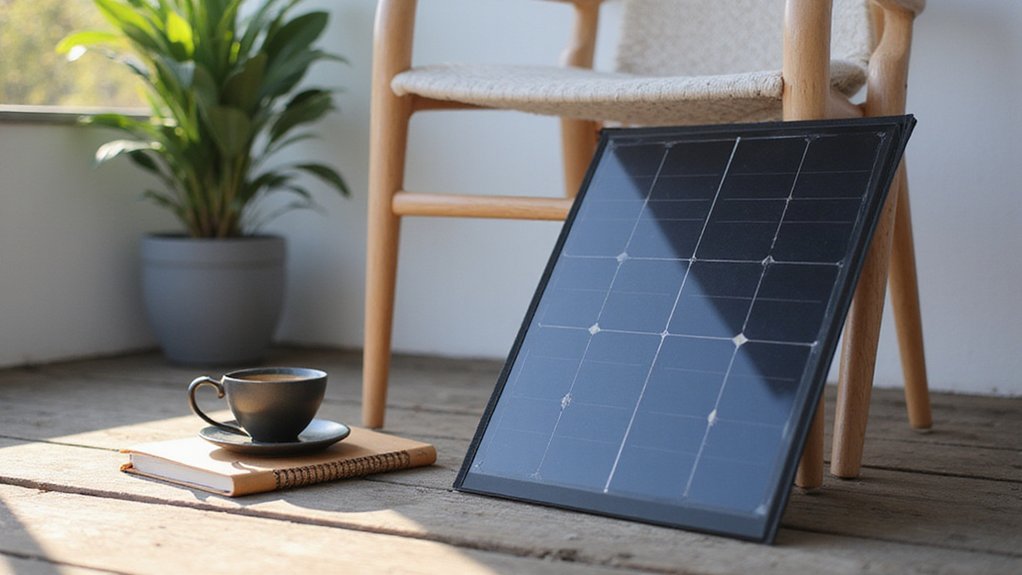

Are you trying to decide between amorphous and monocrystalline solar panels for your roof? Your choice mainly depends on how much space you have and how much power you need.
Monocrystalline panels are more efficient and last longer.
This makes them ideal if space is limited.
The full details below will help you understand which option is best for your situation.
Why Monocrystalline Is the Better Choice for Most Homeowners
Monocrystalline silicon panels are the top choice for most homeowners because they convert the most sunlight into electricity. With efficiencies ranging from 20% to 23%, these panels produce more power per square foot, allowing you to support larger household energy loads with fewer modules. This space-saving advantage simplifies system installation, especially on small or irregularly shaped roofs, and offers greater flexibility in layout. They also perform better in low-light conditions and higher temperatures, ensuring consistent daily output. When wiring these panels, choosing the correct series or parallel setup can further optimize performance based on your system’s voltage and current needs. The uniform dark appearance of the cells enhances your roof’s aesthetic, fitting seamlessly with modern designs. Additionally, with a typical degradation rate of just 0.5% annually, these panels reliably maintain over 85% of their original output after 30 years, maximizing your energy production over their lifespan. Many of these top-performing models now come standard with MC4 connectors for quick and secure wiring. Pairing a monocrystalline array with a top solar generator ensures dependable backup power during outages.

Package Included: 6 pairs solar panel connectors Male and Female + 6 pairs solar connector pins (male and female) + 1 pair of spanners

Quick Parallel 2 Solar Panels: BougeRV 1 to 2 Y branch cable can parallel 2 solar panels. The kit includes 1 male to 2 female (M/FF) and 1 female to 2 male (F/MM) solar connectors

Y Branch Parallel Connector – Offered in two configurations: 1 male to 2 female (M/FF) and 1 female to 2 male (F/MM) solar connectors, designed to wire 2 solar panels in parallel.
Is the Lower Price of Amorphous Panels Worth the Trade-Off?
Choosing amorphous silicon panels solely for their lower initial cost can be misleading. Although they are roughly \(0.84\ \$/W\) versus \(1.1\ \$/W\) for monocrystalline, their lower efficiency reduces their overall value. Amorphous panels typically have a 6–8% efficiency rate, compared to 15–22% for monocrystalline models. This means you need more panels and greater space to produce the same amount of energy. Increased area results in higher racking, wiring, and labor costs, which can offset or surpass the savings from the initial lower price. To accurately compare these costs, you can use multimeter ohms reading techniques to verify the electrical integrity of the wiring connections. For rooftops with limited space or high power demands, the lower efficiency makes amorphous panels less practical, similar to how distribution blocks with fuses ensure reliable power safety by consolidating connections. Monocrystalline panels generate more usable energy per square meter, making them typically more cost-effective over the long term. Unless you have abundant space and minimal energy needs, the trade-off favors choosing higher-efficiency panels despite their higher upfront cost. Conducting a full home energy audit can reveal how much space you truly have and whether your consumption patterns justify the larger array.

[Easy to Install & Use] The lightweight and flexible design makes installation a breeze. simply paste it on any surface or sew it onto fabrics. its compact size (12 x 6cm) ensures it fits perfectly in various setups without taking up much space.

Flexible Design: Made from amorphous silicon, this lightweight and bendable solar panel can be easily rolled or shaped to fit various surfaces, perfect for DIY projects, portable setups, and outdoor adventures.

This is a 2W 6V triple-junction flexible amorphous silicon thin film solar panel with open circuit voltage 7.2V and short-circuit current 350mA. Adopts triple composite layer photovoltaic technology, which separately absorbs red, green and blue full-spectrum sunlight, generating more power than ordinary single-layer solar panels under the same light condition. Standard test condition: 1000W/m² light intensity, AM1.5 spectrum, 25℃ cell temperature.
Which Solar Panel Type Lasts Longer: Monocrystalline or Amorphous?
Monocrystalline panels last significantly longer than amorphous ones, often delivering 25 to 35 or more years of reliable operation. They degrade at a slow rate of about 0.3% to 0.5% per year, maintaining higher efficiency over time. In contrast, amorphous panels typically last only 10 to 20 years, with faster degradation due to their vulnerable thin-film structure. The rigid crystalline silicon in monocrystalline panels is much more resistant to UV exposure, weather elements, and physical damage compared to the plastic layer in amorphous panels. When selecting the best components for your solar system’s electrical infrastructure, it is also important to choose top-rated circuit breakers for fuse boxes to ensure safe and reliable power distribution. This durability means you’ll need to replace amorphous panels sooner, potentially offsetting any upfront savings. Although amorphous panels offer more color options and can be lighter and more flexible, their shorter lifespan requires more frequent replacements, making monocrystalline the better choice for long-term use and maximum durability. For a reliable and organized installation, labeling your breaker box with clear, permanent markings helps ensure safe system maintenance. When upgrading your electrical setup, consider installing a whole-house surge protector for comprehensive protection against power spikes.
Does Heat or Shading Hurt One Technology More Than the Other?
Heat and shading impact amorphous panels less severely than monocrystalline panels. Heat increases the temperature coefficient loss for monocrystalline panels by about \(-0.3\%\) to \(-0.5\%\) per °C, meaning their efficiency drops more sharply in hot conditions. Amorphous panels degrade only \(-0.16\%\) to \(-0.38\%\) per °C, giving them greater resilience in high-temperature environments. For overall performance, monocrystalline panels generally offer higher peak efficiency in ideal conditions. When considering overall value, top battery picks with terminals often complement these solar panel choices for reliable energy storage. However, if your electrical setup frequently trips a breaker, a professional should inspect for underlying issues before adding new solar components.
Shading hits monocrystalline panels hardest, with partial shade reducing their output to around 14%. In contrast, amorphous panels maintain about 58% of their output under similar shading conditions. This makes amorphous more suitable for sites with diffuse light or irregular shadows.
When Should You Choose Lightweight Amorphous Over Rigid Monocrystalline?
Choose lightweight amorphous solar panels when weight constraints are a primary concern. Their ultra-thin, flexible design makes them ideal for applications where reducing load is critical—such as mounting on an RV, boat, or tent. Unlike rigid monocrystalline panels, amorphous modules can conform to curved surfaces, providing greater design flexibility for unconventional or limited spaces. For buyers seeking reliable energy solutions, checking top options reviewed can help verify performance across different brands and configurations. Additionally, amorphous solar shingles offer a similarly lightweight and flexible roofing alternative for homeowners who want integrated solar without the added structural load. When installing these panels, understanding how to safely change a circuit breaker ensures you can handle the necessary electrical work at home without risk.
These panels are also perfect for portable use, including camping gear, emergency kits, and remote sensors, where ease of deployment, transport, and storage outweigh maximum efficiency. When working on low-power loads like outdoor lighting or IoT devices, weight and flexibility often matter more than peak wattage. In such cases, the physical adaptability and lightweight nature of amorphous panels make them the better choice over rigid monocrystalline options.


[Extremely Flexible] This flexible solar panel is capable of meeting a wide range of applications where standard panels can be inconvenient to mount, such as on the curved roof of an airstream

21.9% Cell Efficiency: Monocrystalline cells convert sunlight at 21.9% efficiency for the 200W rating off-grid.
How to Decide Which Solar Panel Is Right for Your Situation
Choosing the right solar panel depends on your specific needs and conditions. If space is limited, monocrystalline panels are the better option because they offer higher efficiency—typically between 15 and 24 percent—which means they produce more power per square meter. This makes them ideal for small rooftops or limited areas, offering maximum wattage with less surface area. They are also more durable, with a lifespan of 25 to 30 years, and tend to degrade at a slower rate over time, ensuring longer-term performance and value. For preventing corrosion on battery terminals that connect to your solar system, anti-corrosion sprays can extend equipment life.
On the other hand, if you have ample ground space and are on a tighter budget, amorphous panels can be advantageous. These lightweight panels are flexible and can be installed on curved surfaces, making installation more versatile. Their efficiency is lower—around 5 to 10 percent—so they require about two to three times more area to produce the same amount of power as monocrystalline panels. However, amorphous panels perform better in diffuse light conditions and high heat, providing more steady output throughout the day, even in challenging weather or lighting environments.

New Design: Smaller in size, same output, higher cells effciency compare to most other brands
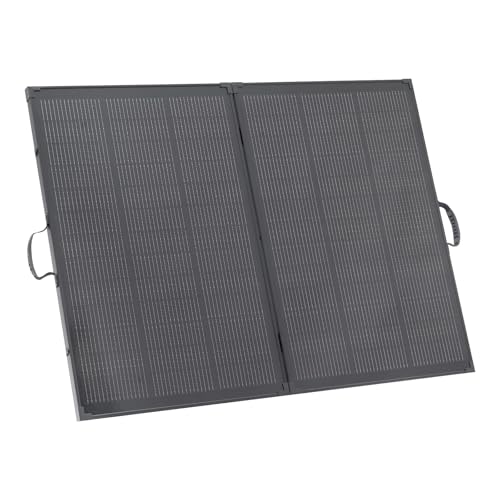
Foldable & Portable: VEVOR monocrystalline solar panel easily folds down into a compact size, making it easy to store and carry anywhere. Perfect for outdoor camping, RV trips, hiking, and emergency use, letting you enjoy solar power on the go

[Industry-Leading 25% Efficiency] 16BB N-Type cells deliver more power from the same sunlight, supporting RV trips, camping, blackout backup, and off-grid use in limited or cloudy conditions.