
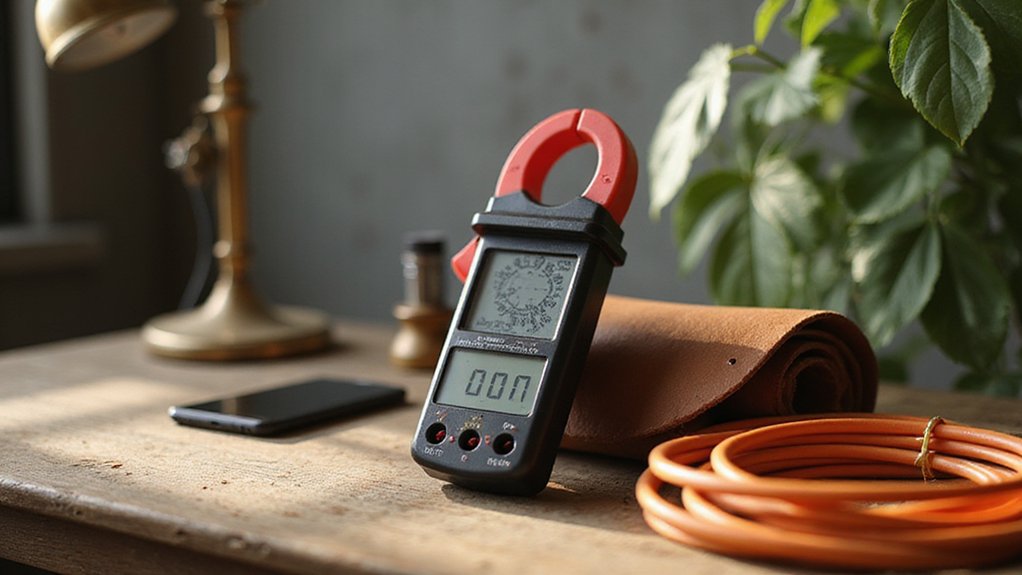

If you’re trying to decide between a clamp meter and a multimeter, your main concern is probably speed versus accuracy.
A clamp meter can measure high currents up to 3000 amps without breaking the circuit but sacrifices some precision.
A multimeter offers much more detailed readings for voltage, resistance, and continuity, though it can take a bit longer to use.
The right choice depends on what you need most—quick checks or detailed diagnostics.
Keep reading to see which device suits your needs best.
The One Big Difference Between a Clamp Meter and a Multimeter
The key difference is that a multimeter requires you to break the circuit and insert its leads in series to measure current, while a clamp meter allows you to measure current without opening the circuit. A multimeter measures current by connecting its leads directly in the path of the current flow, which involves physically breaking the circuit. In contrast, a clamp meter detects the magnetic field generated by the flowing current by simply clamping around a single conductor. This non-contact method keeps the circuit live and unaltered, making it faster and less disruptive for quick checks. However, because it relies on magnetic sensing, a clamp meter may be less accurate when measuring low currents compared to the serial measurement method of a multimeter. For technicians working with live circuits, the clamp meter enhances safety by avoiding direct exposure to energized components. This advantage is especially useful when diagnosing issues in solar panel systems, where MC4 connector disconnection often requires working near live wiring. When selecting a clamp meter for such tasks, looking for models with quality, performance, and value ensures reliable readings without sacrificing safety. This safety benefit mirrors the reason why mechanics always disconnect the negative battery cable first, as it eliminates the risk of accidental short circuits against the chassis.
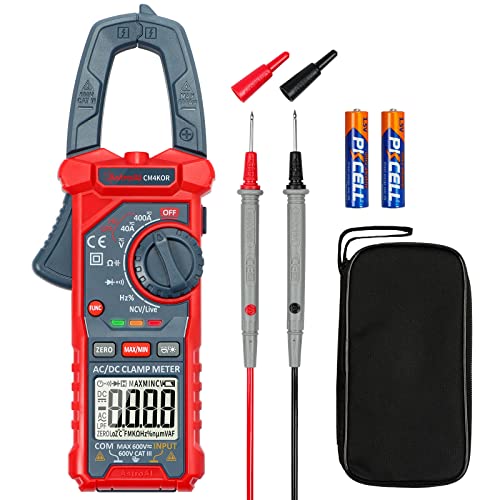
Versatile Digital Clamp Meter: Accurately measures AC/DC Current, AC/DC Voltage, Capacitance, Frequency, Duty Cycle, Resistance, Diode, Continuity and Live Wire Tests. This clamp meter is a really useful tool for solving industrial and household electrical issues.

Important Tips - This CM2K0R clamp meter can not test DC Current. If you have any questions about the product, feel free to contact us! Our California-based support team will respond within 24 hours.

【All-in-One Clamp Multimeter】- Expertly engineered to measure both AC and DC voltage and current—making it an indispensable DC amp meter and voltage meter all in one. With a remarkable maximum current range of 600A, this digital multimeter also tests resistance, capacitance, temperature(k-type thermocouple included), frequency, diode continuity, and live wires. A versatile clamp multimeter ideal for electricians, DIYers, and automotive technicians.
When a Clamp Meter Outperforms a Multimeter
A clamp meter outperforms a multimeter in scenarios involving high current measurements, typically ranging from 300 to 3000 amps. Unlike a multimeter, which is limited to approximately 10 to 20 amps, a clamp meter allows you to measure large currents directly through its jaw without breaking the circuit. This makes it especially useful in industrial settings or when dealing with high-power equipment, as it provides safe, accurate readings without risking damage to the meter or risking personal injury. Its ability to handle these high currents quickly and safely sets it apart from a multimeter, which isn’t designed for such demanding tasks. By avoiding excessive discharge, you can also extend battery lifespan when maintaining backup power systems. For homes with solar installations, clamp meters also help verify the output of integrated solar shingles to ensure optimal performance. Clamp meters like the Fluke 375 and 376 also excel at measuring inrush current by integrating over five cycles for true readings. Solar generators rely on a charge controller to regulate the flow of power and prevent battery overcharging.

【5-in-1 Multifunctional Clamp Meter】Covers AC current (2A/20A/200A/400A max), AC/DC voltage (600V max), resistance (20MΩ max), continuity & diode polarity detection; one-click function switch via FUNC button meets daily & professional electrical measurement needs.

【High Accuracy & Dual AC/DC Measurement】Accurately measure both AC and DC currents from 1mA up to 60A with a resolution of 1mA. Features automatic AC/DC recognition with manual switching option—perfect for automotive and electrical applications.

Compact, easy-to-use clamp meter with 30 mm large jaw taking measurements on large conductors
Three Tasks Only a Multimeter Can Handle Well
A multimeter is essential for tasks like voltage checks on energized circuits, continuity testing with an audible tone, and component-level diagnostics such as resistance, diode, and capacitance measurements. Its high input impedance, around 10 megaohms, minimizes loading effects on sensitive circuits like sensors and control boards, ensuring accurate voltage readings without affecting circuit operation. Continuity testing with an audible tone is unique to multimeters; it quickly helps you locate broken wires or cracked traces without needing to interpret numerical values. For measuring resistance, testing diodes, or capacitance, you rely on the multimeter’s dedicated functions, which clamp meters cannot perform. Temperature measurement and insulation testing are also exclusive to multimeters, requiring contact with probes and specific modes. The probe-based design allows you to precisely contact test points, while clamp meters are limited to non-contact current measurement, making them less versatile for these tasks.
What You’re Giving up on Accuracy With a Clamp Meter
Switching from a multimeter to a clamp meter usually means sacrificing some accuracy in current measurements, especially at low currents. Clamp meters generally specify an accuracy of around ±2% to ±3% of the reading, whereas multimeters often deliver tighter tolerances with direct measurement techniques. Below 1 ampere, this becomes particularly evident: the magnetic field generated by small currents weakens, causing the clamp meter to fluctuate or sometimes register zero. Additionally, if you don’t position the jaw correctly—a common issue—the geometric error increases because the magnetic field isn’t perfectly centered or aligned. External electromagnetic interference can also further compromise the readings.
Calibration becomes more complicated with clamp meters as well. Their accuracy claims are valid only within certain conditions, such as at around 23°C with a ±5°C tolerance. Deviations from these conditions, such as higher frequencies above 60 Hz or distorted waveforms, can significantly degrade measurement accuracy. True-RMS measurement helps improve accuracy with complex waveforms, but bandwidth limitations still affect the results when dealing with harmonic-rich signals. Ultimately, you trade off milliampere resolution and the highest possible precision for the benefit of quick, non-intrusive, and safer current measurements.

Versatile Digital Multimeter - Accurately measures AC/DC Current, AC/DC Voltage, Capacitance, Frequency, Duty Cycle, Resistance, Diode, Continuity and Temperature.

True-RMS Clamp Meter: This multimeter can accurately measure 1000 Amp AC/DC Current, 1000V AC/DC Voltage, Frequency, Duty Cycle, Resistance, Capacitance, Diode, Continuity, and Temperature. Easy to use for labs factories and households
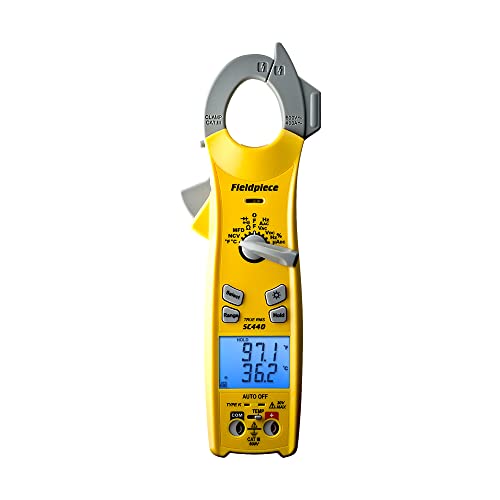
Mid-size clamp meter has every parameter for electrical and thermal HVACR testing in one meter
The Final Word: Clamp Meter vs Multimeter-Which Wins?
For live system measurements, the clamp meter is the superior choice. It allows you to quickly and safely measure current without disconnects or direct contact with conductors. This makes it ideal for fast checks on motors, feeders, or panels, especially in industrial or HVAC settings. Wireless options further enhance remote monitoring and safety. Mastering Battery Load Testing requires a multimeter’s precision for voltage and resistance measurements, not a clamp meter. Notably, the clamp meter’s non-contact current sensing is made possible by a design inspired by cable tie innovations that secure and organize wiring in electrical panels. When selecting a clamp meter, it is important to consider digital clamp meter features such as True RMS accuracy and measurement range.
However, for comprehensive diagnostics beyond current measurement, the multimeter is more versatile. It can check voltage, resistance, continuity, diodes, and capacitance, making it indispensable for troubleshooting electronics and performing detailed tests. Its precision makes it better suited for battery testing and circuit analysis.
Both tools complement each other but serve different primary functions. For frequent, non-intrusive current measurements, a clamp meter is your best bet. For general electrical troubleshooting and detailed diagnostics, a multimeter provides broader utility. Using both ensures you have the right tool for every situation.