
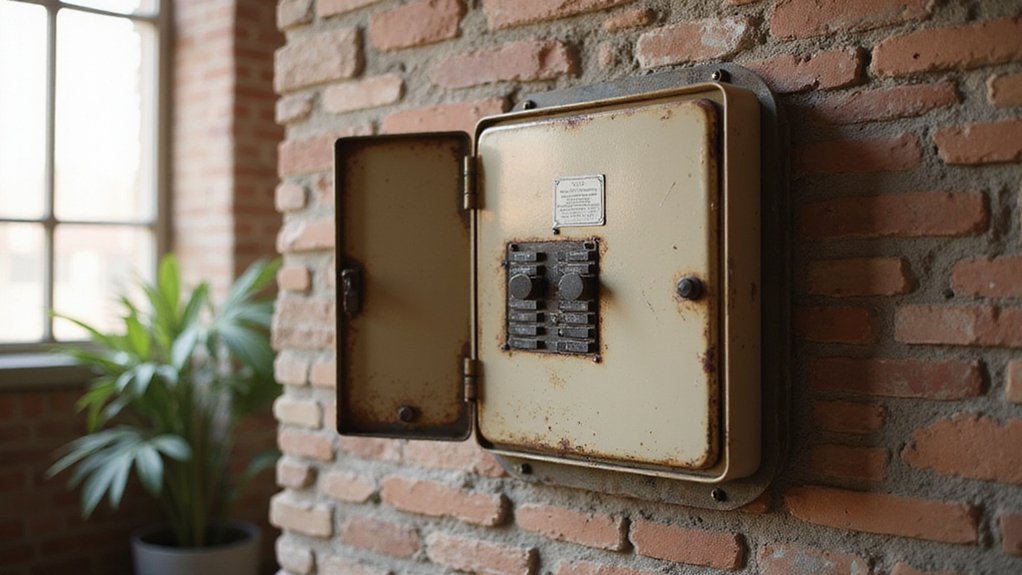

Not sure what type of breaker box you have? Identifying your old breaker box is easier than you might think.
Whether it’s a fuse box with round fuses or a breaker panel with switch rows, recognizing the difference helps you decide if it’s time for an upgrade. Expect to learn how to quickly identify your box and what signs indicate it’s outdated or unsafe.
How to Identify Your Breaker Box in 10 Seconds
To identify your breaker box in ten seconds, start by looking in common locations like the basement, garage, utility room, closet, or outside wall near the meter. The panel is usually a gray or metal box with a hinged door. On the outside or inside of the door, you’ll find labels indicating the panel type. Look for a “MAIN” tag or amperage ratings such as 100 or 200 amps. The individual breakers will have their amperage marked directly on the switch, typically 15, 20, 30, or 50 amps. For solar installations, matching the inverter to the right panel capacity ensures efficient power conversion, which is why solar converters are often reviewed for compatibility.
Breaker styles also provide quick clues. Pushmatic panels use button-style breakers instead of the standard toggle type. Federal Pacific’s Stab-Lok panels feature the Stab-Lok label and red-tipped breakers. Zinsco panels are identifiable by their thin, brightly colored breakers in shades of green, pink, or blue. Additionally, check for a manufacturer nameplate inside the door for confirmation of the panel’s age and type. Watch out for rust, loose components, or crackling noises, as these indicate potential safety hazards that demand immediate attention. Just as with electrical wiring, a cable tie works by using a ratchet mechanism inside the head to grip the serrated strap securely, preventing it from slipping backward. For those looking to upgrade, top breaker box reviews often highlight quality, performance, and value to help buyers choose the best replacement.

Complete 48-Circuit Coverage – Directory sheet, numbered tabs (1–48) with blanks, round number dots, panel/position markers, ON/OFF & safety labels plus a microfiber cleaning cloth.

Complete 48-Circuit Coverage – Directory sheet, numbered tabs (1–48) with blanks, round number dots, panel/position markers, ON/OFF & safety labels plus a microfiber cleaning cloth.

Complete Kit for up to 48 Circuits – Directory sheet, numbered tabs (1–48) with extra blanks, round number dots, panel/room markers, ON/OFF & safety labels plus a microfiber cleaning cloth to prep surfaces for better adhesion.
Fuse Box vs. Breaker Box: Spot the Difference
A fuse box can be distinguished from a breaker box by the presence of round, threaded fuses or block-style cartridge fuses, unlike the row of switches seen in a breaker box. A fuse must be replaced when it blows, which can cause downtime and added cost, whereas a breaker resets easily with a flip of the switch. Fuse compatibility is crucial—you need to install the exact amperage rating for each circuit; using the wrong fuse can increase the risk of fire. Older fuse panels often have faded or missing circuit labels, complicating troubleshooting. Most fuse boxes are limited to 60 amps, whereas modern breaker panels handle between 100 and 200 amps, providing greater capacity and expandability. Breaker boxes also support advanced protective features like GFCI and AFCI breakers, offering enhanced safety options. For optimal network communication in industrial settings, selecting the best RS485 cable ensures reliable data transmission alongside electrical safety. Overall, for increased convenience, flexibility, and protection, a breaker panel is the better choice. For those with multiple batteries, a battery isolator can also help manage charging in a similar way that a breaker manages electrical loads. When using shrink wrap tubing on wiring in a panel, a professional-grade heat gun with adjustable temperature control prevents damage to the insulation.
Can a Fuse Box Be Replaced With a Breaker Panel?
Yes, a fuse box can be replaced with a breaker panel, but the process involves more than just swapping out components. You need to remove the entire fuse box, including its internal bus bars and wiring connections, because fuse sockets are not designed to accept breakers directly. Proper circuit labeling is essential: before disconnecting, carefully map each wire to its corresponding circuit to ensure accurate re-termination in the new panel. Additionally, verify that the breaker panel is compatible with your home’s electrical service size, wire gauge, and grounding system. Upgrading to a breaker panel also allows you to integrate modern accessories like a power inverter for automotive or backup use, though the main panel must handle the load correctly. This upgrade typically requires a permit from your local authority and a subsequent inspection to ensure code compliance. It’s highly recommended to hire a licensed electrician for the job. They will de-energize the existing system safely, install the breaker panel, connect the conductors properly, and test each circuit for safety and adherence to electrical codes. When de-energizing, the electrician follows the same safety principle of disconnecting the negative cable first to prevent accidental short circuits. Using a multimeter set to AC voltage to test each circuit after installation confirms that the proper voltage is present and no faults remain.

GENUINE OEM BREAKER — This offer includes two (2) authentic HOM120 20-Amp single-pole circuit breakers from Square D's trusted Homeline series. The robust thermal-magnetic mechanism is engineered for reliable dual-action protection, responding to both sustained low-level overcurrents and instantaneous high-current short-circuit events. This component is a factory-new, unused Original Equipment Manufacturer (OEM) part, ensuring full compatibility for 120VAC branch circuits.

AUTHENTIC OEM COMPONENT — This kit is built around one (1) factory-new, unused, and authentic Original Equipment Manufacturer (OEM) Square D HOM130 circuit breaker. The Homeline series is Square D's industry-standard line for residential circuit protection, engineered for reliability and precise performance. Ideal for new construction or as direct replacement parts for existing systems.
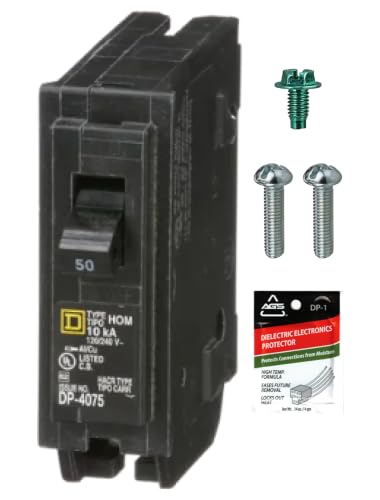
AUTHENTIC OEM COMPONENT — This kit is built around one (1) factory-new, unused, and authentic Original Equipment Manufacturer (OEM) Square D HOM150 circuit breaker. The Homeline series is Square D's industry-standard line for residential circuit protection, engineered for reliability and precise performance. Ideal for new construction or as direct replacement parts for existing systems.
How to Spot a Main Breaker Panel (Gold Standard)
To spot a main breaker panel, look for a large breaker that is significantly bigger than the other circuit breakers—typically rated at 100, 150, or 200 amps. This main breaker is usually located at the top or bottom of the breaker stack inside a gray or metal enclosure. Start outside by locating your electric meter. Follow the service entrance cable from the meter to the panel, often found in the basement, garage, or utility room. Open the panel’s hinged door and check for labels—look for clear markings such as “Main” or “Service Disconnect.” However, if the main breaker is not visible in those standard positions, it may be positioned off to the side or in a separate section of the panel, so check other areas carefully before concluding. The main breaker’s size is stamped on the handle, indicating your entire home’s service capacity. Since it controls all power coming into the house, identifying this oversized switch is key. Additionally, for homes with a generator, you may need to pair this panel with a transfer switch to safely switch between utility and backup power. Once you see the large breaker with proper labeling and the correct amperage stamped on it, you’ve identified the main breaker panel. For portable power needs, a solar charger without battery can be a direct and efficient alternative to traditional backup systems, as reviewed in top product comparisons. Proper maintenance of your battery setup, such as avoiding deep discharges, can significantly extend its useful years.

COMPACT HIGH-CAPACITY PANEL – The PowerMark Gold 200A load center supports up to 40 circuits across 20 spaces. Ideal for residential electrical panel installations requiring efficient, scalable circuit distribution and dependable breaker protection.

Features Siemens plug-on neutral, for simple quick installation, that is spacious with over 4 in. of wire bending space, and a secure reliable installation method

Features Siemens plug-on neutral, for simple quick installation, that is spacious with over 4 in. of wire bending space, and a secure reliable installation method
When You Actually Need a Main Lug Panel
You need a main lug panel when adding downstream electrical capacity from an existing protected circuit, but it cannot serve as the main service entrance. These panels rely entirely on an upstream breaker or disconnect for protection because they do not have a built-in main breaker. Use a main lug panel when extending circuits to a detached garage, workshop, or home addition fed from your main panel. They are also suitable for large properties that require a secondary distribution point closer to loads spread out across the property. Additionally, they are a cost-effective and space-saving solution when fed by a separate feeder circuit. However, you must ensure that a properly protected feeder, with an existing upstream circuit breaker or disconnect, is already in place. Never use a main lug panel as the primary service equipment; it is designed solely for downstream distribution within an existing protected circuit. Properly labeling the feeder wires with DIY cable labels can prevent confusion during installation. A battery tester can verify the feeder circuit is de-energized before you begin work, adding an extra layer of safety. Using high-quality battery terminals for the panel’s ground and bonding connections can improve long-term performance and reliability.

HIGHLY EFFICIENT INDOOR LOAD CENTER – The ABB TLM612FCUD 125 convertible load center offers a compact solution with a 125 Amp, 6-Space, 12-Circuit configuration. Ideal for residential applications, this convertible load center ensures efficient power distribution and flexibility, allowing conversion to a main breaker if needed.

Includes feed-thru lugs and a rainproof outdoor cover

Subpanel vs. Service Panel: What’s the Real Difference?
A subpanel cannot serve as your main service entrance because it is fed from a breaker in your service panel. The main service panel directly connects to the utility meter and manages the overall electrical distribution of your building. It also bonds the neutral and ground at this point. A subpanel, on the other hand, functions as a localized distribution hub, typically installed in areas like garages, workshops, or home additions to handle additional circuits. If you are distributing power to multiple remote subpanels or high-current devices, a fuse block can offer a different method of overcurrent protection compared to a standard breaker. For systems that require isolation between multiple battery banks, a battery isolator ensures proper charging without draining the starting battery.
When upgrading or installing a subpanel, keep in mind it does not increase your total service capacity; it only provides extra breaker spaces. You must maintain a proper separation between neutral and ground in the subpanel to prevent issues like stray current. The feeder cable running from the main panel to the subpanel requires a dedicated double-pole breaker in the main panel. If your main service has enough amperage but lacks space for more circuit breakers, installing a subpanel is an effective solution. For controlling circuits throughout your entire home, stick with the main service panel. Use a subpanel for remote areas or specific zones that need additional circuits without upgrading the entire main panel. For a secure and organized setup, selecting top terminal blocks for DIN rail ensures reliable connections within these panels.
5 Signs Your Breaker Box Needs an Upgrade Now
Frequent breaker trips, flickering or dimming lights when appliances turn on, and signs like burning smells, scorch marks, heat, buzzing sounds, or visible damage indicate your breaker box needs an upgrade. These issues show that your electrical system is outdated or overloaded. Repeated breaker trips across multiple circuits point to an undersized panel that cannot handle modern power demands. Dimming lights under load signal voltage drops caused by worn bus bars or loose connections. A hot panel face or melting insulation suggests arcing, a serious fire hazard. Humming or crackling sounds typically mean failing breakers or compromised wiring. If your fuse box is old, rusted, or overcrowded, your system is obsolete and unsafe. Relying on temporary fixes won’t solve underlying problems; instead, upgrading your panel ensures you gain more capacity, enhanced safety features, and proper support for GFCI outlets and surge protectors. Ignoring these signs puts your home’s electrical integrity at risk—timely professional assessment is critical before minor faults escalate into costly failures. For those considering a replacement, comparing top battery picks for backup power can help ensure your new system supports reliable emergency performance. Additionally, understanding depth of discharge helps maximize the longevity of any backup battery you install, ensuring it remains dependable for years during outages.

Compatibility: Breaker filler plates for Schneider Electric prevents accidental contact with live electrical components, protects against dust and debris, and helps your electrical system comply with standard safety regulations.(with electrical panel label stickers)
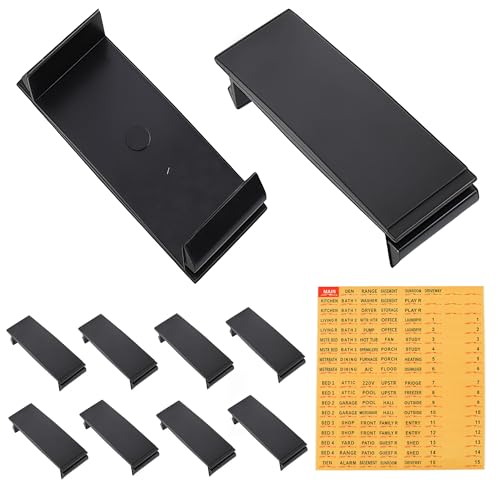
Circuit Breaker Blank Filler Plate 1-Inch breaker panel cover plate safety measure prevents accidental contact with live electrical components, protects against dust and debris, and helps your electrical system comply with standard safety regulations

Used in load centers, CSED devices and NQOD and NF panel boards
3 Mistakes When Replacing an Old Breaker Box
Skipping permit and inspection requirements when replacing an old breaker box is a serious mistake. Permits ensure your work complies with electrical codes, preventing unsafe conditions. Inspections verify proper grounding, appropriate clearances, and panel compatibility. Without these steps, you risk legal trouble, failed insurance claims, and potential safety hazards.
Another common error is installing mismatched breakers. Using only approved breakers for your panel is critical to safety. Foreign or incompatible breakers can cause persistent issues such as frequent trips. Installing a breaker with a higher amperage than the wiring can handle leads to overheating and violates electrical codes. Overcurrent management requires that wire gauge always matches breaker ratings to prevent such dangerous conditions.
Finally, neglecting grounding, bonding, and proper torque on terminations puts your system at risk. Incorrect grounding or loose connections can cause overheating or electrical faults. Always ensure terminals are properly torqued and grounding connections are continuous. These steps are essential for the safe, reliable operation of your new breaker box.