
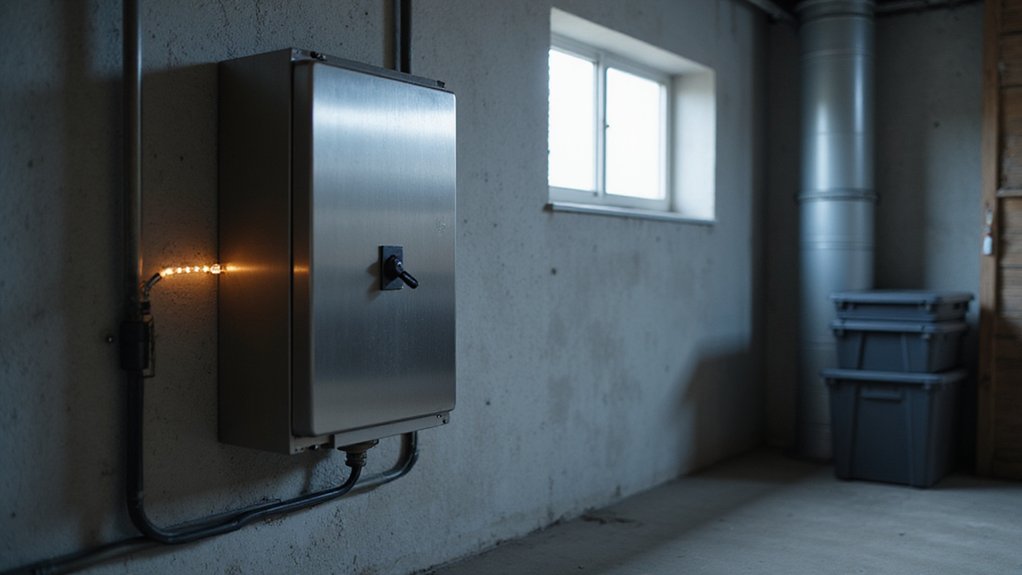

Wondering how your backup power system stays ready to switch on when the lights go out? An automatic transfer switch, or ATS, acts as the control center, monitoring your utility power and seamlessly switching to your generator if it detects a problem.
It does all this instantly, protecting your equipment and ensuring continuous power. Keep reading to see how it works and what to consider when choosing one.
What Is an Automatic Transfer Switch and Do You Need One?
An automatic transfer switch (ATS) is essential for home standby generator systems. It functions as the system’s automatic brain, sitting between your utility supply and backup generator. When the utility power fails, the ATS detects the outage and automatically switches your electrical load to the generator without any manual intervention. This automatic changeover ensures that critical devices, like lights, computers, or medical equipment, remain powered without interruption. The ATS also prevents backfeed—an unsafe flow of electricity back into the utility lines—that could endanger utility workers repairing the grid. Properly sizing the ATS to match your generator’s capacity is crucial; oversized or undersized units can lead to operation issues or safety hazards. Cost and maintenance are additional factors: whole-home transfer switches are more expensive than those designed for critical circuits but provide comprehensive coverage. Regular testing, typically quarterly, is necessary to guarantee reliable performance and code compliance. This function is similar to how a residential sub panel breaker distributes power to specific areas while maintaining safe isolation from the main service. For a similar reason, an ATS relies on precise voltage sensing to initiate the transfer, ensuring the generator is stable before connecting to your home’s circuits. Before working on the ATS or any connected equipment, you must turn off power at the house meter to ensure safety.

Designed for use with single-phase generators, this transfer switch seamlessly transfers power from utility to generator

Functions and Features: 100a 2p dual power auto transfer switch W2R is a PC-level infrequent switching switch, mainly used for automatic or manual conversion of two power supplies, and can test whether the common power supply or backup power supply is normal. When the common power supply A is abnormal, the backup power supply B is quickly switched and put into use within 0.05 seconds to ensure the continuity, reliability and safety of power supply. When the common power supply returns to normal, it automatically switches from the backup power supply to the common power supply. Both power supply A and power supply B can be connected to the mains/generator/photovoltaic, with four wiring.
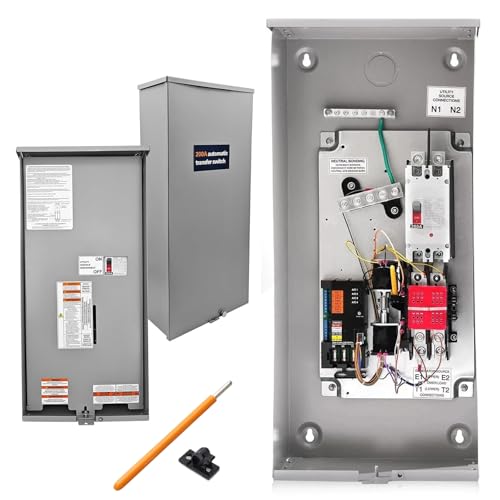
Seamless Power Transitions : This 200 Amp Automatic Transfer Switch is designed to seamlessly transfer the electrical load between a utility (primary) power source and a generator (backup) power source, it powers your entire household, including high-demand appliances, during outages.
How Does an ATS Know When to Switch Power Sources?
An ATS knows when to switch power sources by continuously monitoring the utility supply’s voltage and frequency. It uses built-in control logic that samples all active phases to detect conditions such as undervoltage, overvoltage, underfrequency, or overfrequency. When these readings fall outside preset thresholds—typically voltage below 85% to 90% of the nominal value or frequency under 95%—the ATS interprets this as a utility failure. This function is similar to how a UPS battery backup provides temporary power during interruptions to protect connected equipment. For those investing in backup systems, reviewing top battery picks with terminals ensures the stored power is reliable and efficient. To prevent unnecessary switching from transient issues, the control logic applies a short delay, usually between 0.5 to 3 seconds. If the abnormal condition persists beyond this delay, the ATS initiates the start of the backup generator. It waits until the generator’s voltage and frequency stabilize within acceptance limits, generally around 90% of the nominal voltage and with a stable frequency. In contrast, a fuse block consolidates multiple circuits and protects them individually, rather than managing power source transitions. Only then does it transfer the load to ensure a reliable and stable power supply.
Where Are ATS Units Used in Homes, Hospitals, and Data Centers?
ATS units are typically installed at the transfer point between utility power and backup sources in homes, hospitals, and data centers. In residential settings, you’ll usually find them with utility-to-generator standby systems, supporting essential circuits such as refrigerators, sump pumps, and lighting. This arrangement prioritizes critical loads, providing continuity during outages, but it does not usually cover the entire house. For homeowners seeking a more affordable alternative, an interlock kit can serve as a manual option for safely connecting a generator to a home’s electrical panel without a dedicated ATS.
In hospitals, ATS units are installed in emergency power systems that connect the utility and backup generators to essential circuits like operating rooms, intensive care units, and life-safety systems. They ensure a near-seamless transfer of power to protect patient safety and avoid interruptions during power disturbances.
Data centers use ATS units to connect utility power, backup generators, and uninterruptible power supplies (UPS). These units are installed at key transfer points to protect servers and networking equipment from downtime. Their purpose is to prevent backfeeding and ensure safe isolation of power sources, which is critical in environments where even minimal interruptions can lead to significant operational and safety risks. Facility design may require multiple configurations based on redundancy needs, but utility-to-generator setups are common. For residential installations, expert reviews suggest pairing an ATS with a surge protector to safeguard connected circuits from voltage spikes.

AUTOMATIC WHOLE-HOME BACKUP ACTIVATES THE MOMENT UTILITY POWER FAILS: senses an outage, starts your compatible Generac generator, and transfers your entire panel automatically, unlike a manual interlock kit requiring hands-on action every time
Functions and Features: 100a 2p dual power auto transfer switch W2R is a PC-level infrequent switching switch, mainly used for automatic or manual conversion of two power supplies, and can test whether the common power supply or backup power supply is normal. When the common power supply A is abnormal, the backup power supply B is quickly switched and put into use within 0.05 seconds to ensure the continuity, reliability and safety of power supply. When the common power supply returns to normal, it automatically switches from the backup power supply to the common power supply. Both power supply A and power supply B can be connected to the mains/generator/photovoltaic, with four wiring.

Efficient switching and stable power supply: AC120V 20Amp intelligent conversion switch, precise switching between dual power sources. Stable working voltage, rapid conversion, less than 30ms, ensuring equipment operation. Using high-quality relays to avoid arcing. IP65 protection, suitable for both indoor and outdoor use. Flame retardant material, safe and reliable. Compatible with standard cables, easy to install, providing continuous and safe power support for various electrical appliances
Open vs. Closed Transition: Which Mode Fits Your Automatic Transfer Switch?
Open changeover is the simpler mode, using a break-before-make sequence that causes a brief power interruption during transfer. It does not require switch synchronization, making it suitable when your loads can tolerate a momentary power gap. This mode is often backed by UPS systems that provide ride-through during the short outage. A similar principle applies to vehicle battery maintenance, where disconnecting the negative terminal first prevents accidental short circuits and sparks. For generator connections, using heavy-duty extension cords with proper ampacity ratings ensures safe power delivery during open transition periods. For those planning to hardwire a generator, choosing the best interlock kit can also provide a simpler and cost-effective power transfer solution. Conversely, closed changeover executes a make-before-break process, paralleling both sources temporarily to ensure continuous power. This prevents any interruption but demands that both power sources are synchronized and stable. Closed changeover is ideal for mission-critical systems like data centers where even a 100-millisecond gap is unacceptable. However, it relies on stable voltage regulation from all sources; if your utility or generator cannot maintain this stability, open changeover becomes the better option. Your choice hinges on how critical uninterrupted power is for your system and whether your sources are compatible and well-regulated.

【Compatible Models】Generator Interlock Kit Compatible with Square D QO or Homeline 150 or 200 amp panels.

Generator interlock kits are available for Square D QO and Homeline 150 and 200 amp panels.

【Complete Interlock Kit】Includes 2x CJX2-2510 contactors (110VAC, 25A, 3P + 3NO+1NO) & 1x mechanical interlock bracket.
What Are the Real Benefits of an Automatic Transfer Switch?
An automatic transfer switch (ATS) offers several key benefits beyond simply switching power sources. It provides continuous, reliable power by transferring loads within milliseconds during an outage, which drastically reduces downtime. This quick response ensures that critical operations remain online without interruption, preventing potential financial losses caused by short outages or power inconsistencies. Because the transfer happens automatically, recovery is faster and eliminates the delays associated with manual intervention, preserving the functionality of lighting, computers, and industrial processes without requiring resets or restarts.
Safety is significantly improved with an ATS. It eliminates the need for manual handling of live circuits during outages, reducing the risk of electrical shock and preventing backfeeding into utility lines. This safety feature is crucial during dark or stressful conditions where manual transfer could be hazardous. Additionally, the stability provided by an ATS protects sensitive electronics and machinery from damage due to sudden power loss, which can lead to premature equipment failure.
Modern ATS units are designed to blend seamlessly into various setups, with sleek and space-efficient configurations that do not compromise aesthetic value. While the upfront cost may be higher than manual switches, they deliver considerable convenience through fully automatic operation. Compliance with standards such as UL 1008 and NEC ensures safe, code-aligned emergency power management, eliminating the need for manual labor, reducing human error, and simplifying emergency power procedures. Unlike generators that require starting without a pull cord, an ATS removes all manual handling of power sources during an outage.
How Do You Choose the Right ATS for Your Load and Source?
To choose the right ATS for your load and source, start by accurately sizing it to the electrical demand. Include the total current for every circuit, not just the generator’s nameplate rating. Remember to account for motor starting currents and transformer inrush. Add a margin of 125 percent for continuous loads to ensure capacity, then round up to the next standard ampere rating. Your ATS should be rated higher than the largest value calculated among the load, generator full-load amps, or main breaker rating.
Next, verify that the source matches the ATS requirements. Ensure voltage, phase, and frequency align exactly with each power source. Confirm the alternate source can handle the intended load, especially during starting transients. Compare the available fault current with the ATS’s withstand and close-on ratings, and select a current rating based on the source that imposes the highest stress. For setups with sensitive neutrals or multiple sources, determine if a switched neutral design is necessary. Skipping these checks could compromise safety and reliable operation.

Functions and Features: 125a 2p automatic transfer switch for home generator W2R is a PC-level infrequent switching switch

Seamless Power Transitions:125A generator transfer switch Designed for seamless switching from mains to standby power, whether in industrial, commercial or residential environments, it ensures uninterrupted power to gas generators, solar power, dryers and stoves and more to meet the varying needs of users.

【Dual Power Automatic Tranfer Switch】: The automatic transfer switch is an online switching relay that facilitates the transition between the primary power source and the backup power source. In the event of a power outage from the primary source, the load power is seamlessly switched to the backup source. Conversely, when the primary power source is restored, the load power is switched back to the primary source.
What Are the NEC Code Requirements for ATS Installation?
To ensure compliance with NEC requirements for ATS installation, you must select approved, listed equipment specifically designed for emergency use, such as automatic, electrically operated, mechanically held transfer switches under Article 700. Your ATS must transfer only emergency loads and have sufficient capacity to handle all connected loads simultaneously, including fault-current withstand capabilities. Separate raceways for emergency wiring are required to prevent accidental connection with normal sources. For optional standby systems covered by Article 702, a double-throw, open-transition switch is necessary, and if you serve the entire facility, it must be service-entrance rated. Proper grounding and neutral arrangements are vital, and balancing loads across phases helps ensure reliable generator operation and system stability. When shrinking any protective insulation during installation, heat shrink tubing can be safely applied using a common household hair dryer on a high heat setting as an alternative to a heat gun. During final connection, follow the step-by-step wiring order to prevent backfeeding and ensure safe load transfer between sources. Always adhere to manufacturer instructions and obtain local authority approval before proceeding with installation. Before energizing, verify that all terminal connections are torqued to the manufacturer’s specified values, a critical step that prevents costly mistakes like loose lugs overheating under full load.
Common ATS Mistakes and How to Keep Your Switch Running Reliably
Most reliability issues with automatic transfer switches stem from a few common mistakes. Incorrect phase sequencing can cause severe damage; always verify that the phase rotation matches your generator. Reversing the sequence can lead to equipment failure and costly repairs. Using conductors that are undersized is another frequent error; it causes overheating and unnecessary shutdowns. Ensure cables are rated for the appropriate current and length to prevent overheating. Just as with a battery load tester, first-time setup requires verifying correct settings to avoid initial failures. Adopting simple habits like periodic load testing can significantly extend the switch’s operational life.
Loose power connections are a major culprit for failures. Tighten every terminal and connection to the manufacturer’s specifications to avoid arcing and contact welding, which compromise switch reliability. After maintenance, always return the selector to the Auto position. Leaving it in Manual or Test disables the emergency transfer capability and can result in critical failures during an outage. Upgrading to MC4 connectors ensures a secure, weatherproof connection that reduces the risk of loose power connections.
Your maintenance routine should include inspecting contact surfaces for signs of pitting or erosion, verifying sensing circuits, and performing supervised transfer tests. Skipping these steps accelerates wear and increases the risk of switch failure when you need it most. Infrared thermography can identify hot spots early, helping prevent unexpected breakdowns. Proper upkeep ensures your transfer switch remains dependable, protecting your facility during power emergencies.

Compatible with 12500W Generators: This manual transfer switch handles up to 50A and 10 circuits, allowing you to quickly switch from the main power to your generator with just the flip of a switch. It provides peace of mind and is a temporary power source during outages

Functions and Features: ATS transfer switches G2R is a PC-level infrequent switching switch, mainly used for automatic or manual conversion of two power supplies, and can test whether the common power supply or backup power supply is normal. It can switch power supply (can be city power grid and inverter power supply)in 0.05 seconds to build uninterruptible power supply. When the normal power is abnormal, the spare power works at once, which therefore ensures the continuirty, reliability,and safety of power supply. When the normal power supply is normal, it will automatically switch back from the backup power to the normal power supply

TRC SURGE GUARD AUTOMATIC TRANSFER SWITCHES