

Most people think you need a sprawling roof to make solar worthwhile, but that’s simply not true. The right panels can turn even a small house into a serious energy producer, saving you hundreds each year. Let’s look at four models that actually deliver real returns, no wasted space required.
| SUNGOLDPOWER 500W Solar Panel (10-Pack) |  | Best Performance | Power Output: 500W per panel (10-pack, 5000W total) | Cell Efficiency: 21.05% | Cell Type: Monocrystalline (PERC Half-Cut) | VIEW LATEST PRICE | Read Our Analysis |
| ECO-WORTHY 400W Solar Panels N-Type 4pcs 100 Watt 18V Monocrystalline |  | Best Efficiency | Power Output: 100W per panel (4-pack, 400W total) | Cell Efficiency: Up to 25% | Cell Type: Monocrystalline (N-type) | VIEW LATEST PRICE | Read Our Analysis |
| 100W Portable Solar Panel CPC Material USB-C PD3.0 & 20V DC XT60 Anderson |  | Most Portable | Power Output: 100W per panel (single) | Cell Efficiency: 23.5% | Cell Type: Monocrystalline (CPC) | VIEW LATEST PRICE | Read Our Analysis |
| Renogy 100W 12V Solar Panel Starter Kit with 30A PWM Controller |  | Best Starter Kit | Power Output: 100W per panel (single, starter kit) | Cell Efficiency: 22.5% | Cell Type: Monocrystalline | VIEW LATEST PRICE | Read Our Analysis |
More Details on Our Top Picks
SUNGOLDPOWER 500W Solar Panel (10-Pack)
You want a powerhouse setup for your small house without sacrificing rooftop space. The SUNGOLDPOWER 500W 10-pack delivers exactly that, thanks to Mono PERC Half-Cut Technology hitting 21.05% efficiency. That’s serious output per square foot.
- Size: Each panel runs 82.4 by 44.6 inches, roughly 54 pounds.
- Durability: IP68 waterproof rating handles rain and snow.
- Certifications: UL 61730 and TUV approved, so you’re covered.
- Warranty: You get 12 years on workmanship, plus 25 years on linear performance.
These work for off-grid, on-grid, or hybrid setups. For a small roof, they’re a smart, space-efficient bet that cuts long-term costs.
- Power Output:500W per panel (10-pack, 5000W total)
- Cell Efficiency:21.05%
- Cell Type:Monocrystalline (PERC Half-Cut)
- Waterproof Rating:IP68
- Panel Weight:54 lbs per panel
- Warranty Coverage:12-year workmanship, 25-year linear performance
- Additional Feature:PERC half-cut cell technology
- Additional Feature:25-year linear performance warranty
- Additional Feature:12-year workmanship warranty
ECO-WORTHY 400W Solar Panels N-Type 4pcs 100 Watt 18V Monocrystalline
Need high efficiency without sky high cost? The ECO-WORTHY 400W kit delivers exactly that. You get four 100W monocrystalline panels, each with advanced N-type cells and 16 busbar technology, hitting up to 25% conversion efficiency. That’s better than standard P-type panels, plus they last longer.
Installation is a breeze. You’ll find plug-and-play MC4 connectors and pre-drilled holes for quick mounting. Use them for your RV, shed, or small house system:
- Total power: 400W
- Per panel: 18V, 4.96A max
- IP68 junction boxes with bypass diodes
They handle low light well, work in heat up to 176°F, and come with a 30-day return policy. A solid, affordable choice.
- Power Output:100W per panel (4-pack, 400W total)
- Cell Efficiency:Up to 25%
- Cell Type:Monocrystalline (N-type)
- Waterproof Rating:IP68 (junction box)
- Panel Weight:Not specified (lightweight per description)
- Warranty Coverage:Manufacturer’s warranty (not specified length)
- Additional Feature:N-type 16 busbar cells
- Additional Feature:Up to 25% efficiency
- Additional Feature:Pre-installed bypass diodes
100W Portable Solar Panel CPC Material USB-C PD3.0 & 20V DC XT60 Anderson
Looking for a solar panel that won’t weigh you down? This 100W portable panel weighs just 6 lbs and folds into a laptop-sized bundle (15.7×10.5 inches). You get high efficiency with 23.5% conversion, powering your devices through USB-C PD3.0 at 45W or USB-A QC3.0 at 24W.
It’s built tough with CPC material and an IP65 waterproof rating, perfect for camping or RV trips. You’ll appreciate the auto-reboot feature as light conditions change. Plus, you can charge 99% of power stations using the included XT60, Anderson, or DC connectors. Setup takes seconds with four kickstands and grommets for hanging. A 12-month warranty backs it up.
- Power Output:100W per panel (single)
- Cell Efficiency:23.5%
- Cell Type:Monocrystalline (CPC)
- Waterproof Rating:IP65
- Panel Weight:6 lbs
- Warranty Coverage:12-month warranty
- Additional Feature:6-fold laptop-bag design
- Additional Feature:USB-C PD3.0 45W output
- Additional Feature:XT60/Anderson connectors included
Renogy 100W 12V Solar Panel Starter Kit with 30A PWM Controller
For a small house setup where simplicity and ease of expansion matter, the Renogy 100W 12V Solar Panel Starter Kit with 30A PWM Controller is your entry point into off-grid energy. You’re looking at a monocrystalline panel with 22.5% cell efficiency, beating most rivals by 1.3%, and it cranks out roughly 500Wh daily. That’s enough to keep a few lights and a fridge running.
The kit’s built tough: UL certified, withstands 2400Pa wind and 5400Pa snow loads, with IP65 and IP67 weatherproofing. You can expand up to 400W by adding panels, and it plays nice with AGM, Gel, Flooded, or Lithium batteries.
The Wanderer controller includes a Bluetooth port, so you’ll monitor everything via the Renogy DC Home app. You get a 10-year panel warranty and a 2-year controller coverage. It’s a solid, expandable start.
- Power Output:100W per panel (single, starter kit)
- Cell Efficiency:22.5%
- Cell Type:Monocrystalline
- Waterproof Rating:IP65 (junction box), IP67 (connectors)
- Panel Weight:14.1 lbs
- Warranty Coverage:10-year panel materials, 2-year controller, 25-year power output
- Additional Feature:30A PWM controller included
- Additional Feature:Bluetooth remote monitoring
- Additional Feature:5400Pa snow load rating
Factors to Consider When Choosing Solar Panels for Small House
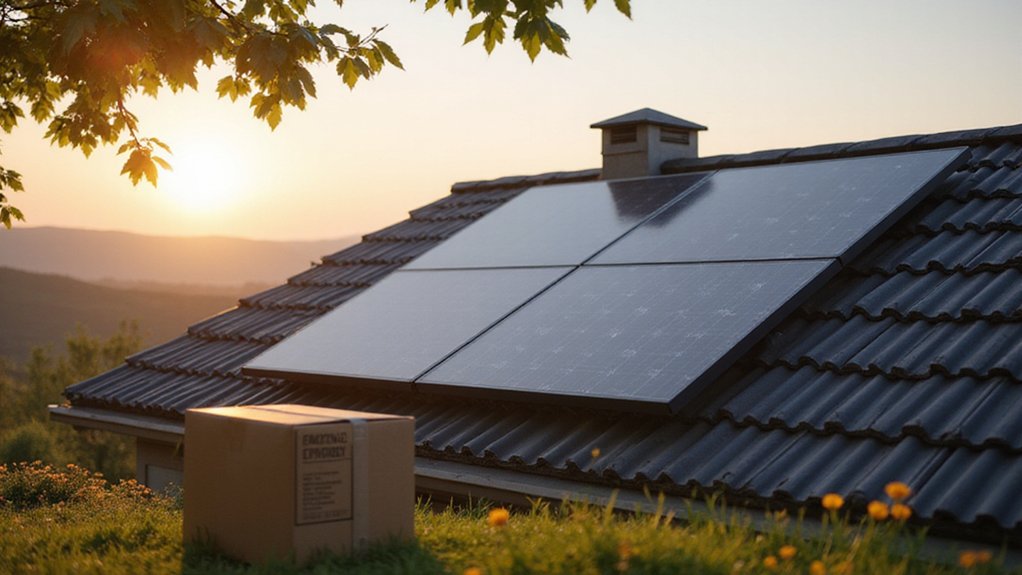
You’ll want to focus on size and footprint first, since your small house likely has limited roof or ground space. Then, consider your power output needs alongside weight and portability, especially if you plan to move the system. Don’t forget durability and weatherproofing, plus system compatibility, to guarantee everything works together without a hitch.
Size and Footprint
The size and footprint of your solar panels will directly shape how they fit into your small house setup. You’ve got limited roof or yard space, so every inch counts. Larger panels pump out more energy, but they’ll hog room you might not have. That’s where monocrystalline panels shine. They’re the space-savers, delivering higher efficiency in a smaller footprint than polycrystalline or thin-film options.
Before you buy, grab a tape measure and map out your available area. You need exact dimensions to avoid overhang or awkward placement. Consider this:
- Measure your roof’s length and width.
- Note any obstructions like vents or chimneys.
- Check for shading from trees or neighboring buildings.
These steps help you select panels that fit snugly, optimizing energy production without sacrificing your property’s look or function. It’s a smart move that pays off!
Weight and Portability
Size and footprint matter, but weight and portability are just as important when you’re working with a small house. Lighter panels, like those 100W portable models weighing around 6 pounds, make transport and installation a breeze. You can easily lift them onto a rooftop or a temporary setup without needing a crane or a second pair of hands. For maximum flexibility, consider foldable panels. They’re perfect for seasonal setups or if you’re renting and need to move. Heavier panels, over 50 pounds, can complicate things. They often require extra support structures and make solo installation tough. By choosing a lighter option, you reduce labor and keep the safety factor high. It’s a simple way to make certain your solar setup stays manageable!
Power Output Needs
First, figure out your daily energy consumption in watt-hours: that’s the bedrock for matching panels to your small house. Grab your last electric bill or tally up your devices’ usage. Then, divide that number by the average peak sunlight hours in your area. This gives you the total power output you need from your array.
You’ll want to choose panels with a higher wattage rating, especially if you live somewhere with less than stellar sun. This guarantees you’re still producing enough energy on cloudy days. And don’t overlook panel efficiency. Higher efficiency panels pack more power into a smaller footprint, which is perfect for tight spaces.
Finally, add a buffer for system losses. Things like wiring, inverters, and heat degrade performance. A good rule of thumb: size your system 20% higher than your calculated needs. That way, you’re not left in the dark.
Durability and Weatherproofing
Now that you’ve crunched your wattage numbers, let’s talk about making sure your panels can handle whatever the weather throws at them. You’ll want an IP rating of at least IP65. That means they’re sealed against dust and water, so a downpour won’t faze them. Look for tempered glass, corrosion resistant frames, and reinforced junction boxes. These features help panels shrug off hail, wind, and snow loads without cracking or warping.
Don’t forget to seal every electrical connection with waterproof connectors and protective coatings. That prevents corrosion and water damage over time. For humid or coastal areas, choose anodized aluminum frames. They resist rust and keep performance strong for years. Short version: durable panels pay off, because they keep working through every season without surprise failures.
System Compatibility
You’ve got durable panels picked out, so now let’s make sure they actually play nice with your small house’s electrical system. Check that the panel voltage and wattage match your house’s requirements and any battery storage you’ve got. You’ll need seamless integration with your inverter, charge controller, and wiring setup, or you’ll face mismatches. Don’t forget the maximum input capacity of your components. This matters if you plan to expand later. And verify the connectors. Whether they’re MC4, XT60, or Anderson, they must match your existing system for a smooth hookup. Finally, confirm that everything aligns with your available space and structural support. Skip this step, and you’re just buying headaches. Get it right, and you’ve got a system that actually works for your small house.
Installation Simplicity
One factor that can make or break your solar setup is installation simplicity, especially when you’re working with limited space and time on a small house. Look for panels with pre-drilled mounting holes and plug-and-play connectors—you’ll thank yourself later. Lightweight, foldable designs are a game-changer, cutting handling time dramatically. You want clear, step-by-step instructions and compatibility with standard hardware.
Here’s what streamlines the process:
- Integrated stands or adjustable supports for easy positioning.
- All-encompassing accessories like extension cables and quick-hang features.
And avoid anything requiring custom brackets or extra drilling. That just adds frustration. Stick with panels that include everything you need for a fast, no-fuss setup. Your back and your schedule will appreciate it.
Battery Type Support
Three key things matter when checking battery type support. First, you must guarantee your panels and charge controller match your battery chemistry whether it’s AGM, Gel, Flooded, or Lithium. Lithium batteries, for instance, need a specialized controller to prevent overcharging, so don’t skip that verification. Second, verify your panels operate within your batteries’ voltage and current limits. Mismatched specs cause inefficient, even unsafe, charging. Third, look for an MPPT controller over a PWM one. MPPT extracts more power and handles higher voltage arrays beautifully, giving your batteries a better, longer life. You’ll also need to confirm your system supports high voltage or high capacity batteries if you plan to expand. Just pick components that talk the same language, and you are set.
Warranty Coverage Length
Since warranty coverage tells you how long the manufacturer stands behind their product, you’ll want to pay close attention to the length of coverage when choosing solar panels for your small house. Longer warranty periods, from 12 to 25 years, signal greater confidence in durability and performance. Aim for a 25 year warranty; it typically covers both workmanship and performance, guaranteeing your panels keep pumping out energy for decades. Shorter terms? That’s a red flag you’ll likely face more maintenance or replacements down the line, eating into your savings.
But don’t stop at the years. Dig into the details. Verify what’s actually covered: defects, damages, or performance drops. A linear performance guarantee, for example, ensures output degrades predictably over time. Get the specifics. That way, you’re not stuck with a promise that diminishes faster than your panels!