


If you’re trying to get the most out of your solar panels, you’ve probably wondered how to maximize energy capture.
An MPPT charge controller is a smart device that continuously adjusts to draw the highest possible power from your panels.
It can boost your system’s efficiency by up to 30% compared to simpler controllers.
Keep reading to see how it works and what to consider for your setup.
What Exactly Is an MPPT Charge Controller: and Why Do You Need One?
An MPPT (Maximum Power Point Tracking) charge controller is an intelligent DC-to-DC converter that optimizes the energy your solar panels produce. It continuously adjusts the voltage and current to match the optimal power point of your panels, often extracting 15% to 30% more energy than a standard PWM controller. This efficiency helps you get the most out of your system, especially when sunlight is less intense or temperatures are lower. To maximize compatibility and performance, the best solar panels for MPPT controllers use MC4 connectors for secure and efficient connections. When integrated with a backup generator, an MPPT controller works with automatic transfer switches to ensure seamless power management during outages. For those seeking a complete solution, many of the top-rated systems pair MPPT technology with top solar generators for reliable power backup.

【Superior MPPT Technology】 This 100A MPPT solar controller is equipped with an advanced MPPT maximum power point tracking technology algorithm. It automatically recognizes 12V/24V/36V/48V systems and features dual USB 5V charging ports. The controller can swiftly track the maximum power point of the PV array in any environment, ensuring a tracking efficiency of no less than 99.5%. This significantly enhances the energy utilization in the solar system.

ADVANCED 40A MPPT SOLAR CHARGE CONTROLLER: This Dyness MPPT solar charge controller continuously tracks solar panel output and combines multiple MPPT algorithms for efficient charging under changing weather and temperature conditions. Supports up to 600W at 12V or 1200W at 24V, with PV input below 100Voc.
How Does an MPPT Controller Find the Maximum Power Point?
An MPPT controller finds the maximum power point through a continuous, real-time process. It repeatedly measures the solar panel’s voltage and current to calculate power (P = V × I). Using the Perturb and Observe method, it slightly adjusts the operating voltage and observes the change in power. If power increases, the controller continues in the same direction; if not, it reverses course. This iterative hill-climbing approach causes the controller to oscillate around the peak power point, optimizing energy harvest. This is similar to how a UPS battery backup maintains a steady output during power fluctuations.
For increased stability, the Incremental Conductance method compares the rate of change of current with respect to voltage (ΔI/ΔV) to the negative ratio of current and voltage (–I/V). When the slope of the power-voltage curve (dP/dV) reaches zero, indicating the maximum power point, the controller stops perturbing. This method provides a more precise and reliable tracking, especially under changing environmental conditions. For the best overall system reliability, consider selecting a controller with high quality terminals that ensure secure and efficient connections. When selecting your equipment, consider a breaker box that matches your system’s voltage and amperage requirements. It’s also essential to ensure your battery bank’s voltage profile matches the controller’s output. During installation, verify voltage and current ratings to prevent damage and ensure proper system operation. Proper matching and real-time tracking enable the MPPT controller to efficiently maximize energy harvesting from your solar panels.
How Much More Energy Does an MPPT Controller Really Harvest?
MPPT controllers can typically harvest 15–30% more energy than PWM controllers over a full day. The most common gains fall between 18–25%. These differences come from MPPT’s higher conversion efficiency, which ranges from 95–99%, compared to PWM’s 70–80%. The advantage is especially noticeable when panel voltage exceeds battery voltage, such as during cold weather, where voltage mismatch is greater, pushing gains toward 30%. This increased voltage mismatch is why a secure roof mount can make a difference in overall system performance, as it helps maintain optimal panel alignment and temperature management. When panel voltage closely matches battery voltage, the benefit drops to about 10–15%. Battery type and voltage also influence how much extra energy MPPT can recover. Charging lower-voltage batteries from higher-voltage panels yields more benefit. This is because the controller actively tracks the maximum power point to optimize the transfer of voltage and current. Cost is a key consideration: the higher upfront price of MPPT controllers is often justified by the increased annual harvest. In systems with a 12V battery and a 24V panel, you may recover the additional cost within a few years thanks to the increased daily watt-hours harvested. For those seeking the best setup, pairing an MPPT controller with Best Battery Straps ensures secure mounting and optimal performance of the entire solar system.
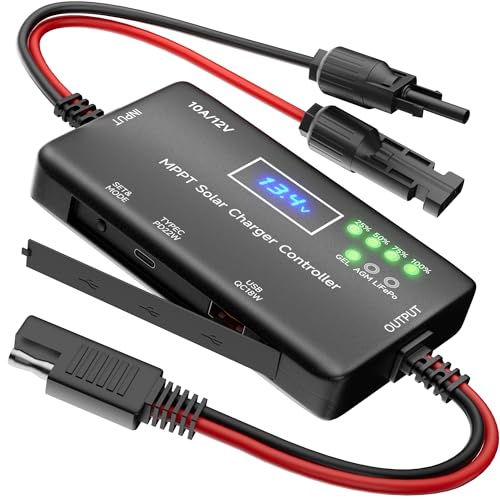
12V Solar Charge Controller: This MPPT charge controller is specifically designed for solar panels that do not have an integrated controller. It is not compatible with solar panels that have built-in controllers. Note: It is only suitable for 12V batteries and must not be used with 24V or 36V battery packs. Please note: This unit does not include a polarity converter and must be connected with correct positive/negative polarity

Superior MPPT Technology: Renogy MPPT Solar Charge Controller achieves a 98% conversion rate&99% tracking efficiency, ensuring maximum solar panel charging even in low-light or partial shade. Advanced MPPT algorithm rapidly adapts to changing conditions.

SMART SOLAR CHARGE CONTROLLER: Solar charge the smart way with the Victron Energy SmartSolar MPPT charge controller, to ensure that every ray of available sunlight is converted into usable energy, while optimizing battery longevity.
Where MPPT Shines: Top Applications for Maximum Solar Efficiency
MPPT charge controllers provide the most value in off-grid homes, RVs, and remote telecom sites. They excel at utilizing high-voltage photovoltaic (PV) strings, which minimize voltage drop over long wire runs and reduce wiring costs. This makes them ideal for situations with extensive wiring distances or limited space for thicker conductors. Their dynamic tracking capability ensures batteries are charged efficiently even under shifting cloud cover, maximizing energy harvest during variable weather conditions.
In mobile living environments, MPPT controllers allow you to wire residential panels in series, simplifying installation and decreasing current losses. For larger solar arrays, MPPT systems are cost-effective because they require fewer combiner boxes and smaller conductors, which lowers overall balance-of-system expenses. Commercial and industrial setups also benefit, as higher-voltage strings cut down on conduit costs and improve overall system efficiency, making MPPT controllers the preferred choice for maximizing solar energy production across diverse applications.

SMART SOLAR CHARGE CONTROLLER: Solar charge the smart way with the Victron Energy SmartSolar MPPT charge controller, to ensure that every ray of available sunlight is converted into usable energy, while optimizing battery longevity.

[Upgraded] 1.Superior MPPT Technology: Equipped with an advanced MPPT solar charge controller, this device boasts a tracking efficiency of up to 99% and a conversion efficiency of 98%. It significantly boosts energy harvest from your solar panels, making it one of the most efficient charge controllers in its class.

HASSLE-FREE PLUG & PLAY: Skip the confusing setups. With smart 12V/24V auto-recognition, installation is a breeze. Simply connect your battery first (ensuring a base charge for auto-detection) followed by your solar panels, and let the controller do the rest.
MPPT vs. PWM: Which Charge Controller Wins for Your Solar Setup?
MPPT charge controllers generally outperform PWM units, especially in larger or more complex solar setups. They actively convert excess voltage from your panels into additional current through DC-DC conversion, which can increase energy harvest by 5 to 30 percent, particularly in cold climates where panel voltage rises. This higher efficiency makes MPPT controllers ideal for expansive arrays that need to maximize every bit of energy. They also adapt well to changing conditions, providing more usable charge across different weather and sunlight patterns. For instance, combining an MPPT controller with a well-maintained 48V battery bank can significantly extend the battery’s real-world lifespan by optimizing the charge profile.
In comparison, PWM controllers work best for small systems where panel voltage closely matches the battery’s chemistry. They simply switch the panels’ connection to the battery, dragging panel voltage down to match the battery voltage, which results in lower energy transfer efficiency. While PWM units are more affordable and easier to set up, their performance drops as system size grows or conditions become less ideal.
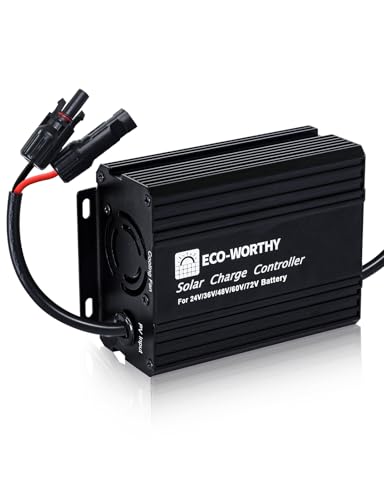
【Boost Charging】Boosts the voltage of 12 V or 24 V solar panels to charge 24/36/48/60/72 V batteries in Golf Cart, Electric Vehicles, and Solar System Kit; No need to add additional solar panels or change the connection of solar panels

【True MPPT Tech | 30% More Solar Power Harvest】Our authentic MPPT solar charge controller delivers up to 30% higher charging efficiency than basic PWM controllers, maximizing energy capture from your 12V solar panels for non-stop power. Engineered exclusively for 12V battery systems (RV, boat, shed) – the perfect solar upgrade for off-grid living and outdoor gear. ⚠️It is NOT compatible with 24V/36V batteries or panels with built-in controllers.

Notes to buyers ①Designed for 12V/24V batteries, please don't connect to higher voltage batteries. ②The PV can not exceed 60V. ③Connection sequence: first connect the battery, then connect the solar panel.
4 Key Specs for Choosing an MPPT Charge Controller
To choose an MPPT charge controller that works safely and efficiently with your setup, four key specifications must be verified. First, ensure the controller’s battery compatibility by matching it to your battery bank’s voltage—12V, 24V, 48V, or an auto-select mode. This guarantees proper charging and avoids damage caused by voltage mismatches. Second, calculate the maximum charge current needed by dividing your solar array’s total wattage by your battery voltage, then add a safety margin of around 25 percent to handle current spikes and temperature fluctuations. Third, confirm that your controller’s photovoltaic input voltage rating exceeds your array’s open-circuit voltage, especially in cold weather when Voc can increase. This prevents overvoltage issues that could damage the controller. Fourth, check the temperature ratings to ensure the controller can operate within your environmental conditions. Most controllers derate their output above 40°C, and typical operating ranges span from -30°C to +60°C. Ignoring these specs can lead to poor charging performance or system failure. For optimal performance, pairing your controller with a top pure sine wave inverter ensures clean AC power output from your stored energy. Many top inverter models also include integrated battery chargers that work seamlessly with MPPT controllers for efficient energy management. When selecting a controller, also consider models that are compatible with various inverters to ensure seamless integration and maximize system reliability.
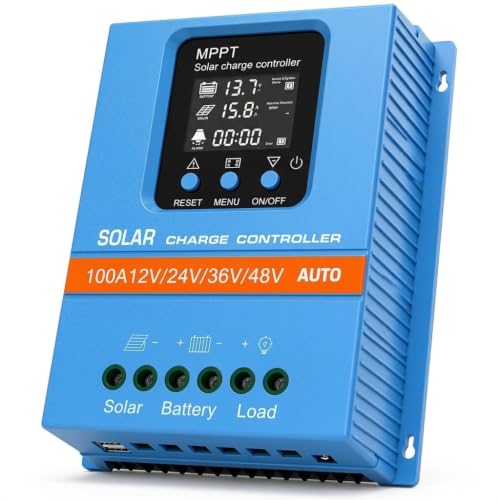
【Product Advantages 】: 100A intelligent adjustment controller with precise time control and light control, can switch loads on and off at a fixed time, adjustable voltage...