
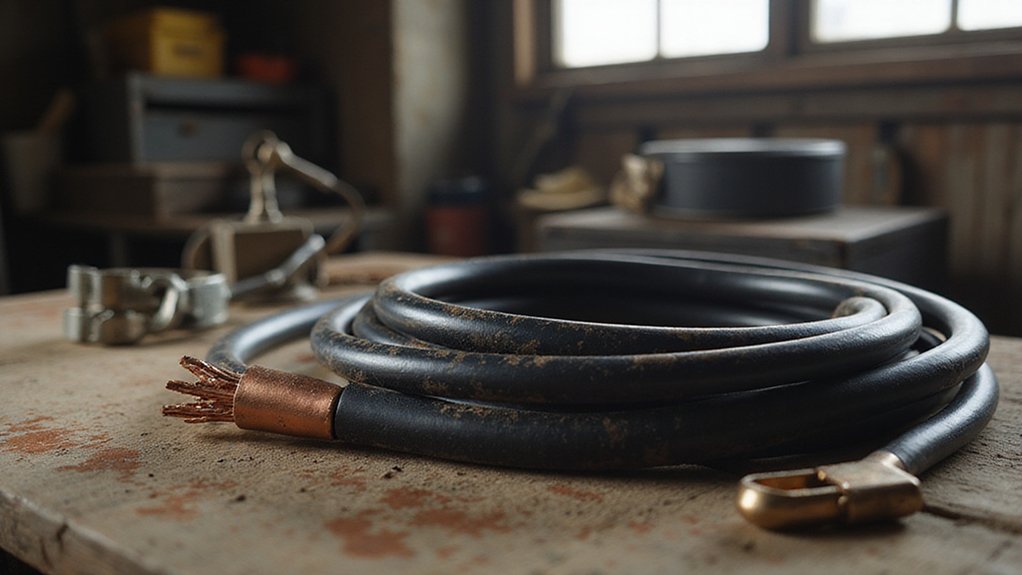

Figuring out the right gauge for your battery cables can feel confusing, but it’s all about matching your cable size to how much current you’ll draw and the distance it needs to run.
Using the correct gauge ensures safety, minimizes voltage drop, and prevents overheating.
In this guide, you’ll learn how to choose the right wire size based on your power needs and setup.
Keep reading to find exact specs, tips on lugs, and safety advice to get it right the first time.
Why Undersized Battery Cables Cause Voltage Drop and Fire Risk
Undersized battery cables cause significant voltage drops and increase fire risk because their limited cross-sectional area results in higher electrical resistance. This resistance converts electrical energy into heat, leading to voltage sag that can impair system performance. For example, a 12V system experiencing a 0.5V drop across the cable reduces the available voltage by over 4%, which can cause inverter shutdowns or weak engine cranking. The heat generated by this resistance, especially when cables are bundled or enclosed, deteriorates insulation and softens the cable jacket. Once insulation melts, live conductors are exposed, creating a direct short circuit and a potential fire hazard. Because the cable behaves like a fuse wire under overload, the risk of ignition escalates as current flows increase, overwhelming the thermal limits of the insulation. Properly sizing cables for continuous current and run length is critical to prevent these issues and ensure safe, reliable operation. Connecting the negative battery cable first is a safety risk because it can complete a circuit and cause sparking near the battery, but proper gauge selection is equally critical for preventing fire hazards. Choosing cables from top battery picks with terminals can help ensure the connector quality matches the gauge requirements for a secure, low-resistance connection. A cable’s tensile strength rating, much like that of a cable tie, must be matched to the load to avoid mechanical failure under stress.
Match Battery Cable Gauge to Your Current Draw and Run Length in 3 Steps
To match your battery cable gauge to your current draw and run length, start by measuring the one-way cable length from the power source to the load. Double this measurement to account for the round-trip distance, as resistance affects both directions. Next, decide on your voltage-drop limit: 3% for critical loads like inverters and pumps, or 10% for less sensitive equipment. Then, use a voltage-drop calculator or refer to a cable gauge chart, inputting your current, total round-trip length, and chosen voltage-drop percentage. The point where these values intersect indicates the minimum AWG size you should use. Keep in mind that real routing situations often include bends and connectors, each adding resistance. It’s also important to verify that your cable’s insulation rating can handle the heat generated under your maximum load.

【High Quality】A ABIGAIL battery cables are made of pure copper and tinned copper lugs with superior corrosion and oxidation resistance, which improves the oxidation resistance of copper and maintains its conductivity better.

Battery cables - 2ft/60cm 8 AWG gauge inverter cables contain set of positive (Red) and negative (Black) battery cables.

[ Package Includes ] 10 pcs 1/0 gauge (AWG), 3/8" (M10) stud battery cable lugs with 10 pcs 3:1 marine grade dual wall adhesive heat shrink tubes
Exact Ampacity Limits for 6 AWG to 4/0 AWG at Typical Run Lengths
For typical run lengths, the ampacity limits for copper battery cables range from 55 to 405 amps depending on the wire gauge. Specifically, 6 AWG can support 55 to 75 amps, allowing for around 11.8 feet at 50 amps but only about 2.2 feet at 300 amps. 4 AWG handles 85 to 140 amps, with an approximate length of 18.8 feet at 50 amps decreasing to 3.1 feet at 300 amps. 2 AWG supports 115 to 190 amps, making it suitable for longer midrange runs. 1/0 AWG can carry over 150 amps, often used for large inverter feeds. 4/0 AWG is rated for 195 to 405 amps, supporting about 95.2 feet at 50 amps or approximately 15.8 feet at 300 amps. When pairing these cables with solar panel systems, ensure the connectors are rated for MC4 compatibility to match high-current requirements. A grounding wire is also crucial in these systems to provide a safe path for fault current and prevent electrical shock hazards. Selecting a solar panel kit with properly rated cables and connectors can simplify the installation process.
Keep in mind that the cable’s insulation rating — whether 60°C, 75°C, or 90°C — directly affects these ampacity values. Higher insulation ratings permit higher current capacity. Always ensure the connectors you select are compatible with your cable gauge, particularly for fine-strand cables, to achieve secure connections and prevent voltage drops at joints.
The Right Battery Cable Gauge for Automotive, Marine, RV, and Solar Systems
Selecting the right gauge cable depends primarily on your maximum current draw and the one-way cable length, not just the battery type. To determine the appropriate size, start by measuring the peak amps your system will draw. Then, note the cable length from power source to load, ensuring you account for one-way distance. For automotive applications, small cars typically use 6 to 4 AWG cables, while large trucks may require 1/0 AWG to handle higher current demands. Marine systems, exposed to saltwater, benefit from tinned, flexible copper cables in sizes from 4 AWG to 2/0 AWG to resist corrosion and withstand vibration. RV wiring often uses 2/0 or 4/0 AWG cables, especially for inverter runs, to keep voltage drop below 3 percent. In solar setups, smaller gauge cables are fine for panel-to-controller connections, but high-current battery links demand significantly larger sizes to reduce voltage loss. When choosing a solar inverter, the best solar converters for inverters can handle high peak loads while maintaining efficiency. Always aim for a voltage drop of no more than 3 percent on sensitive circuits, and choose a cable gauge that matches your actual load rather than estimated needs. Following correct installation practices, such as tightening connections to the proper torque, prevents dangerous arcing and overheating in high-current systems. Understanding the composition of solar panels helps buyers choose durable wiring that can withstand environmental exposure and maintain efficient energy transfer.

Heavy Duty 4 Gauge Marine Wire:Our 4 AWG marine wire is made of tinned copper to make sure good conductivity,corrosion resistance, high durability,flexibility,stability for a long-lasting performance

【High Quality】A ABIGAIL battery cables are made of pure copper and tinned copper lugs with superior corrosion and oxidation resistance, which improves the oxidation resistance of copper and maintains its conductivity better.

6-Pack 4 AWG Battery Cable Set: Includes 3 red positive and 3 black negative 4 gauge battery cables, each measuring 12 inches (30 cm). The matched cable set is ideal for connecting batteries in parallel or series and for short power connections between batteries, inverters, bus bars, and electrical systems
Battery Cable Lugs, Fuses, and Installation Safety Tips
Choose the correct size of battery cable lugs by matching the inner diameter of the ring lug to your battery or fuse-holder stud size, such as M8 or M5. A proper fit ensures good electrical contact and minimizes resistance. Avoid using spacers between the lug and the terminal, as they can increase contact resistance and cause heat buildup. Crimp the lug securely using a compatible crimping tool, and then perform a pull test to confirm the connection is solid. For a quick verification, you can also use a multimeter set to check for voltage drops across the lug connection. Place the fuse within 8 inches of the battery’s positive terminal, reducing the length of exposed conductor and decreasing the risk of short circuits. During installation, disconnect the power, remove any jewelry, and wear gloves and safety glasses to prevent injury. Tighten fuse-block hardware to the manufacturer’s specifications, ensuring washers do not disrupt the electrical path. Keep tools away from both positive and negative terminals to avoid accidental bridging, which can cause overheating or fires. For balcony systems, review your solar panel specifications to ensure the battery cable gauge matches the panel’s output current requirements. Following these steps helps ensure a safe, reliable battery circuit with low resistance. For a clean and reliable finish, always strip the wire insulation to the exact length recommended by the lug manufacturer, avoiding nicks in the bare copper strands to prevent weak points.
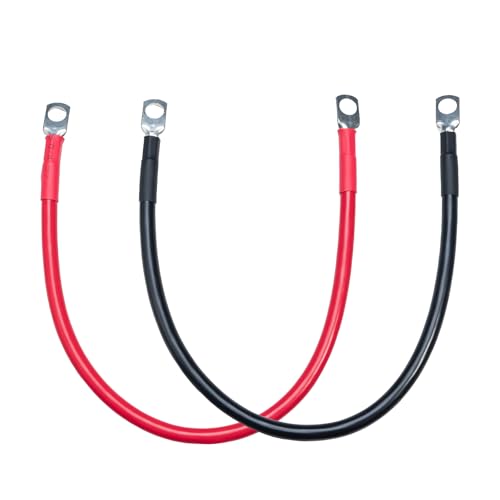
Cables Set: 2 gauge battery cables, includes 1 positive wire(red) and 1 negative wire(black)

The battery terminal connector is made of high-quality pure copper material, which is resistant to high temperature and corrosion and achieves maximum conductivity.

1. Premium Material:Our battery cables are made of the finest pure copper, for unparalleled conductivity and long-term stability.